
 “Thinking is a pre-requisite to behavior.”
This comment was made early on during an amazing dialogue between Cognitive Coaching creators Art Costa and Bob Garmston and Jim Knight on one of Jim’s Thursday Facebook Live interviews. The fascinating hour-long conversation among these global thought leaders passed by so quickly that I plan to listen to it again.
After a brief warm-up question (during which we hear about Art’s 67-year marriage and Bob’s decision to give up his Porche for a VW bus), Jim Knight smoothly transitioned into an exploration of the origins and impact of cognitive coaching.
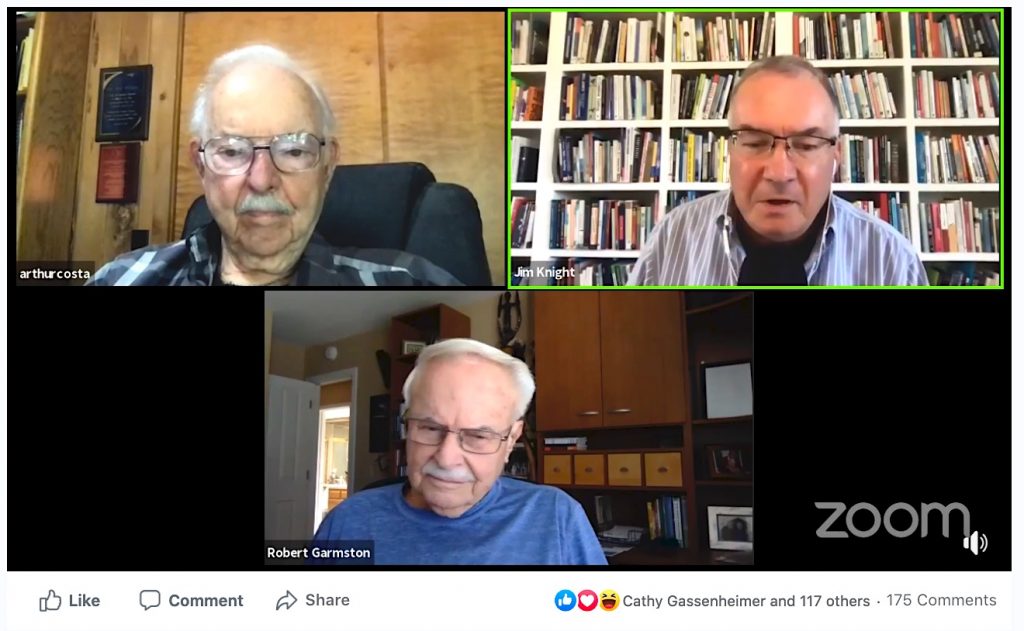
Jim began the interview by inviting the pair to talk about the the origins of Cognitive Coaching. Garmston explained that he was hired to work with Art Costa in the mid-1980s at California State University. They shared an office, so they began to learn more about each other’s work, not only in dialogue but in overheard phone conversations.
Costa was steeped in the science of thinking and cognition and, at the time, Bob’s expertise was in the areas of relationships and psychotherapy. They soon recognized they could build on each other’s strengths.
As Costa explained, most coaching at the time was about changing behavior. Bob and Art believed, however, that to change behavior you first had to change thinking.
It was such a privilege to listen to these two giants of education, relaxed in their homes, thinking outloud with Jim Knight as they explained the people they studied under and the process they used to craft cognitive coaching.
Some of the gems from the dialogue include:
- At any given time, a teacher’s thinking represents her/his understanding and perceptions. The role of a cognitive coach is to help that teacher gain greater clarity and direction.
- Cognitive coaches mediate thinking to help stretch their coachee’s thinking using the five states of mind used in Cognitive Coaching: flexibility, interdependence, craftsmanship, efficacy, and consciousness.
- “When people develop their own direction, they remember and usually apply it.” – Bob Garmston
- “[We believe the] resources live within the person being coached. The cognitive coach’s role is to help them access those resources.” – Art Costa
Tools and Skills
During the hour, there was a fascinating dialogue between Costa and Garmston about “tools” and “skills.” It’s inspiring to see these two independent intellects( in their late 80s!) still energetically processing ideas and forming opinions from their own understandings.
 Costa suggested coaches use both tools and skills: Tools are things used by people of different professions. Skill involves the way the tools are employed. As an example, he pointed to listening as a tool and noted most of us aren’t good listeners. It is only through practice and intentionality that we strengthen the skill of listening.
Garmston disagreed with Costa’s distinction, suggesting the skills encompasses the tools. I have to admit, I’m with Costa on this one. His example on listening convinced me!
When asked to identify the most important skills and tools, Costa and Garmston pointed to listening, paraphrasing, the ability to ask good questions, and the use of language. More about the first three can found in here, here, and here.
As an example of the use of language, Garmston noted the importance of using positive presuppositions. For example, a coach might begin a question with something like: “Drawing on what you know…” The use of that phrase affirms the coachee and also helps him/her bring forward their working memory.
Social Emotional Learning
As the conversation drew to a close, Costa mused on one of our favorite focus areas, social and emotional learning. Because stress causes the brain to secrete cortisol and close down, it is important for coaches to recognize the emotion, label it correctly using the correct intensity. Costa gave the following example: if coaching someone who is agitated, it is important to gauge whether they are at the level of being annoyed, angry, or outraged and use the appropriate descriptor.
According to Costa, once the emotion is labeled, it offers relief and can help the person move into action. Both Costa and Garmston stressed the necessity of developing a robust vocabulary: “The more granular the vocabulary is, the better equipped the coach is to match the emotion.”

Be sure to watch the Concise Conversations chat with Jim Knight this Thursday on Facebook Live. Join Cathy & Jackie at 1 PM Central on the ABPC Facebook homepage.
Regarding students and SEL, Costa urged teachers and parents to help kids identify and name their feelings, so they can begin to self-manage. This process can begin with professional learning for teachers: “Helping teachers to become more self-directed helps teachers help students to become more self-directed.”
So, if thinking is a prerequisite to behavior, we have the opportunity during Covid-19 to work on our thinking and the thinking of others. Thankfully, we have Art Costa and Bob Garmston to help us strengthen our thinking tools and skills. As Garmston says in the video, with Costa and Knight nodding affirmatively, “An overarching goal of…coaching is to promote self-directed learning.”
Spending an hour listening to these three giants in the coaching field will produce more than one “aha moment.” I can promise you that!
Resources
► The entire interview with Costa and Garmston.
► Costa & Garmston’s first article together, “Supervision for Intelligent Teaching,” appeared in Educational Leadership in February, 1985.
► Garmston’s 1993 article for Educational Leadership, “Reflections on Cognitive Coaching,” offers a close-up look at his own coaching style in the early years of Cognitive Coaching.
► In the past, both Garmston and Costa have been generous to share their expertise with the ABPC.
► In this 2017 blog post, “3 Cognitive Coaching Skills Everyone Can Put to Use,” I wrote about our Cognitive Coaching retreats at Children’s Harbor, where participants learned about cognitive coaching’s purpose and our roles as CC coaches in training.

