

In this three-part series, author and ABPC senior consultant Jackie Walsh shares research-based strategies that can invigorate the classroom learning environment, making it a place where student participation in rich academic conversations is routine.
In Part 1, Jackie highlights the five-stage discussion model she and co-author Beth Sattes recommend in their new ASCD book. In Part 2, she introduces introduce three student capacities essential for productive discussion: social skills, cognitive skills, and use-of-knowledge skills. In her final post, Part 3, Jackie explains how teachers can scaffold conversational skill-building, using three forms of classroom discussion.
You may also be interested in listening to a webinar featuring Jackie and Beth, hosted by ASCD in December 2015. It’s free and simple to use!
 by Jackie Walsh
Imagine students listening actively to one another, seeking to understand, respecting different points of view. Imagine these students taking time to think before they speak and then voicing what they know or believe clearly and confidently.
 Imagine these same students using knowledge to support their statements, asking questions when confused or curious, taking their thinking about an issue or topic deeper or in different directions. And imagine them supporting one another, building on classmates’ ideas, encouraging everyone to become engaged in this academic conversation.
These student skills enrich classroom dialogue as my colleague Beth Sattes and I define it in our new ASCD book, Questioning for Classroom Discussion. The subtitle of the book, Purposeful Speaking, Engaged Listening, Deep Thinking, summarizes what we believe to be the core qualities of a true discussion.
Most students don’t bring these skills with them
How many students possess these skills when they arrive in our classrooms? You’ll most likely agree with classroom researchers: very few. And yet many teachers (and I was one of these) attempt to engage students in discussion without attending to the development of these skills. This is a recipe for unproductive experiences that can repeat themselves throughout the school year.
How can teachers plan for and facilitate discussions that are productive, disciplined, and meaningful? This is the question our book addresses. In this post and two more to follow, I’ll share a big-picture overview of the processes we believe can prepare your students to fully participate in powerful learning discussions.
Planning is key
Good discussions don’t just happen. They are the result of teacher planning, ideally in partnership with students. In Questioning for Classroom Discussion, we present a five-stage discussion model and outline the teacher planning decisions related to each stage. It looks like this:
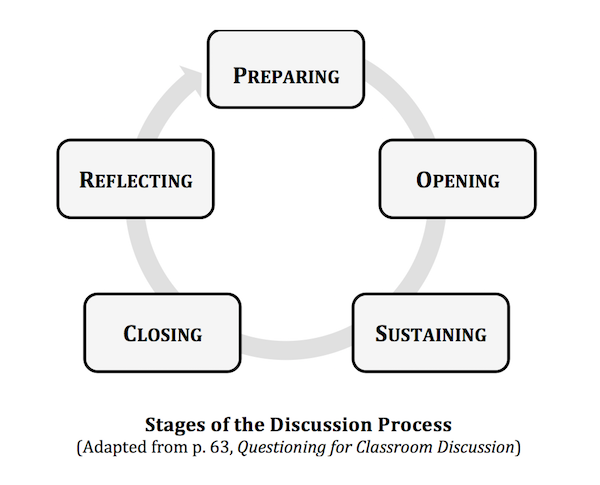
Stage 1: Preparing
One important task during the Preparing stage is the framing of a focus question for the discussion. One carefully conceived and well–formulated question can drive a discussion, whether it’s a 10-minute conversation in a primary classroom or a 45-minute Socratic Seminar in middle or high school.
Our book provides a more detailed step-by-step approach to the framing of a quality question for discussion, which begins with the identification of an issue around which the question will be crafted. The issue should provoke controversy, inspire creative solution-finding, or create cognitive dissonance. Ideally, the issue is one in which students can make an emotional as well as an intellectual investment.
Stage 2: Opening
The intent of singling out the Opening is to underscore the need to focus student attention on the targets for a given discussion and to provide all students a warm-up period, a time to collect their thoughts and get comfortable with their place in the discussion space.

Elementary classroom setting. Focus on teacher and chalkboard.
One set of targets relates to the specific skills the teacher expects students to intentionally practice during a particular discussion (more about the three categories of skills in my next post). The focus question, of course, expresses the primary target for thinking and interaction. If all students are to engage in thinking—and hopefully interacting—around the question, each one needs this time to activate thinking and practice speaking.
A protocol assists in scaffolding this preliminary thinking. Think-pair-share is a tried-and-true strategy. We offer examples of other such strategies, including the People-graph and Synectics.
Stage 3: Sustaining
If a discussion is to take wings and soar, students will likely require teacher scaffolding at various points. A range of teacher comments and questions can assist students at precarious junctures:
- to sustain an individual student’s thinking and speaking;
- to encourage students to listen to and piggyback on one another’s comments;
- to invite students to rethink a comment that is based on erroneous information;
- to reel students in when they get too far off topic;
- to jump-start students’ thinking in response to silence or stalemate;
- to gently prod non-speakers to participate or monopolizers to give up some of their air time—the list goes on.
Navigating students through the up’s and down’s of discussion requires considerable teacher skill. Our book offers a repertoire of strategies and practices teachers can access to strengthen their facilitation skills.
Stage 4: Closing
While a teacher cannot foresee exactly where student thinking may take a given discussion, he does give forethought to the markers or indicators of a productive or successful discussion. The teacher projects different routes student talk may take and thinks in advance about when and how to handle the Closing.
This may involve the mapping of different lines of thought emerging during the discussion, the identification of questions for future inquiry and discussion, the suggestion that the discussion be continued on another date following time for additional reading and research, and so forth. The point is to identify in advance alternative ways to engage students in a closing that is energizing, empowering, and inspires continued thinking about the issue.

High School Students Taking Part In Group Discussion
Stage 5: Reflecting
Reflecting, the fifth stage in the cycle, acknowledges the importance of learning from and about the process of discussion. During this stage students think about their individual participation—how they contributed in positive (and perhaps not-so-positive) ways to the quality of the classroom conversation.
The teacher also prompts them to think about how they interacted with one another to build collective understanding or broaden perspectives. A focus for student reflection is on the extent to which they were successful in using the skills identified for special attention during that discussion.
The teacher continues Reflecting outside of class by considering how well the focus question and her facilitation moves worked to engage students and sustain productive discussion. Improving discussions and associated student skills is a work in progress.
Next: Building student discussion skills
Our book includes a template that teachers can use to think through and plan for productive discussions. In my next post, I’ll explain what we mean when we say “skills are the means and ends of discussion” and introduce three capacities that we consider foundational for productive discussion: social skills, cognitive skills, and use-of-knowledge skills.
Jackie Walsh is the co-author, with Beth D. Sattes, of Questioning for Classroom Discussion: Purposeful Speaking, Engaged Listening, Deep Thinking (ASCD, 2015). Jackie works with teachers and school leaders across the United States to improve classroom questioning and discussion. She has co-authored three other books on quality questioning.
Jackie is also lead consultant to the A+ Best Practices Center (A+ Education Partnership) where she designs and facilitates professional learning for ABPC’s many educator networks. She lives in Montgomery, AL. Contact Jackie at [email protected] and follow her on Twitter @Question2Think.

