
A+ Education Partnership works to create great schools for every child in Alabama. With one foot in the statehouse and one foot in the schoolhouse, we work to improve outcomes for Alabama students by working with elected and appointed officials to promote policies that improve public education. Our three programs, A+ College Ready, A+ Best Practices Center, and A+ Student Voices Team, build the capacity of students, teachers, and school leaders.
Raising the Bar for Students with A+ Education Partnership
A+ Education Partnership’s policy work is integral to improving academic outcomes for Alabama students. We partner with elected and appointed officials to help shape policies and promote public investments in proven practices that ensure the success of every child in Alabama.
We promote investments in what works, like:
- Research-based practices such as high-quality state-funded pre-k and early literacy supports
- High-quality professional development for teachers, principals, superintendents, and other district leaders
- High academic standards for every Alabama student
- Innovation in schools to meet the needs of today’s students
Mission & Vision
A world-class education for every Alabama student, regardless of circumstance
Driven by our relentless belief in every child, we partner with educators, communities, and policymakers to expand access to a high-quality education so that every student can thrive.
All of our work, from pre-K through high school, is focused on one goal: ensuring EVERY Alabama student graduates prepared for college, career, and life.
Learn more about our work:
A+ College Ready, a program of A+ Education Partnership and the State Department of Education, holds the unshakeable belief ALL students can achieve at high levels. As such, it opens the door for middle school and high school students in Alabama to reach their academic potential through access to Advanced Placement (AP) and other challenging coursework. A+ College Ready provides high-quality professional learning for teachers and leaders to prepare students for success in Advanced Placement coursework while building a strong foundation in middle school to prepare students for success.
Our A+ Best Practices Center (ABPC) supports Alabama’s teachers, principals, superintendents, and other leaders with ongoing network-based, collaborative professional development that is proven to improve student achievement. We know that the top two indicators of student success are well-supported, well-trained teachers and effective school and district leaders. ABPC helps those who serve our students develop the competence, confidence, and courage to do whatever it takes to improve learning.
A+ Student Voices Team believes students’ perspectives should be taken into account when making important policy decisions. The A+ Student Voices Team is a statewide, student-led advocacy group for students in grades 9-12 that works to make education better for Alabama students.
We unite students from across Alabama to ensure we are included in the public policy process. By advocating for student-centered education policies, we ensure students have input on decisions that impact us most.

Every Child Alabama is a coalition of organizations and individuals working to ensure every child across Alabama has access to a world-class education to reach their full potential. We share a unifying belief that when every child receives a transformative education, it strengthens communities, making them better places to live, work, and raise a family.
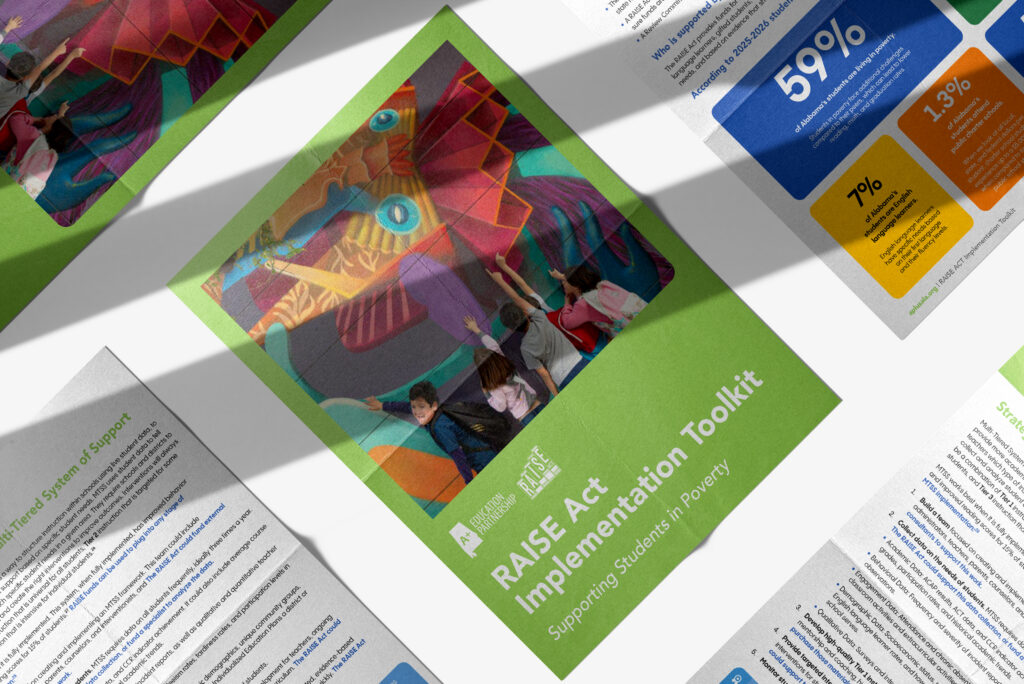
Raise Act Implementation Toolkit
This toolkit is for district leaders, school board members, families, and community members to learn about the RAISE Act implementation. It includes information about the 2025…
Over 35 years of A+ Impact
Since 1991, A+ Education Partnership has worked to improve public education for every student in Alabama. Founded as a nonprofit, nonpartisan organization, A+ has grown from a grassroots advocacy effort into one of the state’s leading education policy and school improvement organizations.
In its early years, A+ focused on building public support for bold education reform. Over time, the organization expanded its work beyond advocacy to partner directly with educators, school systems, state leaders, and policymakers. Today, A+ combines research, policy expertise, leadership development, and direct support for schools to advance lasting improvements in student achievement.
Throughout its history, A+ has remained an independent voice, working alongside state leaders while maintaining the ability to advocate for policies that put students first.
Creating Momentum for Change, 1991–1998
1991
Our Founding
Leadership Alabama alumni Caroline Novak and Bill Smith founded A+ Education Partnership to unite business, civic, government, and education leaders around one shared goal: improving opportunity and achievement for every Alabama student, regardless of circumstance. Novak served as president, Smith served as board chair and led strategy and fundraising, and Cathy Gassenheimer joined the team as managing director.
1991–1996
Building a Statewide Reform Movement
A+ launched a statewide effort to build public support for education reform. More than 23,000 Alabamians participated in town hall meetings that helped create a blueprint for evidence-based school improvement.
The organization’s work attracted support from Alabama businesses and foundations, establishing a strong base for long-term impact. Governor Jim Folsom and Senate leader Michael Figures introduced the Alabama First Plan based on the blueprint. Although the proposal passed the Senate, it did not pass the House. The experience reinforced A+’s long-term commitment to student-centered, data-driven education policy.
1997–1998
Focusing on the Fundamentals First
Focusing on the fundamentals first and creating proof points, A+ helped design and launch the Alabama Reading Initiative (ARI), serving on the state’s reading panel and raising $1.5 million in private funding to support the program’s first two years. ARI would later become a national model for state-led, student-centered reading policy.
To help sustain public investment, A+ published Closing the Gap: How the Alabama Reading Initiative Is Transforming Reading Instruction.
In 1997, A+ also convened the Task Force on Teaching and Student Achievement, resulting in the report Teaching and Learning: Meeting the Challenge of High Standards. The report identifies high-quality professional learning for educators as the most important strategy for improving student achievement.
Translating Momentum into Action, 1999–2008
1999
Launching the A+ Best Practices Center
Cathy Gassenheimer led the creation of the A+ Best Practices Center (ABPC), to expand access to high-quality professional learning for educators across the state. ABPC developed statewide networks of teachers, principals, and district leaders dedicated to sharing effective instructional practices and improving student learning.
2003
Another Statewide Reform Effort
Governor Bob Riley proposed a broad plan to modernize state government, strengthen accountability in education, improve school funding, and reform Alabama’s tax structure. Supported by A+, the business community, and other nonpartisan organizations, the proposal became Amendment One. Although voters rejected the amendment, A+ continued its commitment to promoting policy wins through bipartisan partnerships.
2003–2006
Expanding the Alabama Reading Initiative
A+ worked with Governor Riley, State Superintendent Joe Morton, and Alabama Reading Initiative (ARI) Director Katherine Mitchell to successfully advocate for full statewide funding of the ARI to provide reading coaches, teacher training, and interventions for struggling readers in every K–3 school.
This investment produced nationally recognized results. By 2007, Alabama led the nation with record-breaking fourth-grade reading gains on the National Assessment of Educational Progress (NAEP). By 2011, Alabama students performed at the national average.
2004–2006
Strengthening School Leaders and Teachers
With A+ support, Governor Riley put a strong focus on strengthening teachers and school leadership. He established the Congress on School Leadership, leading to improvements in principal preparation, accountability, and leadership support.
He also launched the Governor’s Commission on Quality Teaching, which developed key strategies for recruitment, preparation, evaluation, support, and compensation to increase the effectiveness of Alabama’s teachers.
2005
Supporting Standards-Based Reform
A+ partnered with Vanderbilt University’s Peabody Center for Educational Policy to publish the Alabama Education Policy Primer, helping educators and policymakers implement Alabama’s response to the federal No Child Left Behind Act.
2006
Expanding High-Quality Pre-K
A+, Alabama Giving, the Alabama Partnership for Children, and Voices for Alabama’s Children created the Alabama School Readiness Alliance (ASRA) to close student achievement gaps by ensuring that all children enter school ready to learn.
The effort helped build broad business, community, and legislative support for continued expansion of Alabama’s nationally recognized voluntary pre-k program, while preserving its mixed delivery model through public schools and private providers.
In collaboration with A+ and ASRA, Governor Riley established the Governor’s Council on Pre-K Policy, which developed the pre-k expansion plan that became known as First Class Pre-K. With strong support from Governors Riley, Bentley, and Ivey, and the Alabama Legislature, the program has grown to serve nearly 50% of Alabama’s 4-year-olds. It has been ranked one of the highest-quality programs in the nation for over 20 years.
2008
College Readiness and the Creation of A+ College Ready
At the request of Governor Riley and State Superintendent Joe Morton, A+ launched A+ College Ready when Alabama received one of only seven $13.2 million grants from the National Math and Science Initiative. The successful program remains a highly effective public-private partnership among A+, the State Department of Education, and the Legislature.
Led by Mary Boehm and Carol Crawford, the initiative expanded access to Advanced Placement coursework by providing teacher training, instructional materials, and incentives for students and schools.
- Between 2008 and 2018, Alabama ranked first in the nation for growth in qualifying AP Math, Science, and English scores — and third for growth among minority students.
- As of 2025, Alabama students have risen to 17th in the nation in success on AP exams.
Scaling Impact, 2009–2018
2010–2018
A+ Best Practices Center Expansion
In its first 20 years, ABPC served 116 of the state’s 139 districts, impacting more than 400,000 of Alabama’s 740,000 students. By 2020, an external evaluation found consistent gains in math and reading among students attending ABPC spotlight schools.
2011–2012
Plan 2020
A+ supported the State Board of Education’s adoption of new College and Career Readiness Standards and a plan to increase graduation rates and prepare students for success after graduation. Plan 2020 focused on raising expectations for learners, professionals, school systems, and the supports in place for students.
A+ organized Alabama GRIT (Graduate Ready. Impact Tomorrow.), a coalition of 52 members, including military families, business leaders, chambers of commerce, educators, and community organizations, to support rigorous academic standards that prepare students for college, career, and life. The coalition succeeded in defeating four attempts to roll back those expectations.
From 2014 to 2019, A+ contributed to a series of six reports produced by the Business Education Alliance, highlighting areas to improve the implementation of Plan 2020.
2012–2017
Supporting Standards-Based Reform
A+ contributed to changes in the state’s assessment and accountability systems to better align with Plan 2020. In 2017, A+ recruited the national Center for Assessment to support a state task force charged with creating a new assessment system tied specifically to Alabama’s standards. This work resulted in the Alabama Comprehensive Assessment Program (ACAP) student assessment system in place today.
Representative Terri Collins sponsored legislation in 2012 requiring the State Superintendent of Education to create a school grading system with A-F letter grades to provide clear, accessible, and publicly transparent measures comparing school proficiency, academic growth, graduation rates, and college/career readiness across districts. A+ supported the Act and served on the initial implementation group. The first State Report Cards for school districts and schools were issued in 2018.
A+ College Ready partnered with state leaders to shape, support, and expand Alabama’s K-12 Digital Literacy and Computer Science standards, which were adopted in 2018.
2015
Charter Schools for Alabama Students and Families
Sponsored by Senator Del Marsh and Representative Terri Collins, public charter school legislation passed in 2015 with A+ support. As one of the last states to authorize public charter schools, Alabama was able to focus on quality and granting charters to groups addressing specific challenges facing underserved students.
2016–2019
A+ College Ready Growth and Middle School Expansion
In 2016, A+ College Ready added courses in social studies and computer science to its original math, science, and English offerings.
In 2019, A+ College Ready launched the Middle School Teacher and Incentive program (MSTIP) to build a pipeline of students prepared for rigorous coursework in high school and beyond. Cohorts of middle schools are now supported, replicating the approach originally designed for high schools.
A 2025 PARCA study found that A+ College Ready’s participating middle schools were outperforming their peers and closing achievement gaps.
Leading the Next Generation, 2018–Present
2018
A New Chapter
Co-founder and President Caroline Novak announced her retirement after nearly three decades of transformative leadership. Co-founder and board chair Bill Smith transitioned to Emeritus Chair.
The Board of Directors selected Mark E. Dixon, former education policy advisor to Governor Bob Riley, as president. Dixon returned to Alabama from Washington, D.C., bringing an MBA in Strategic Management and Public Policy, along with seven years of private-sector experience, to the role.
Under Dixon’s leadership, A+ embraced the philosophy of having “one foot in the State House and one foot in the schoolhouse,” combining policy leadership with direct support for educators and students.
2018
A+ Student Voices Team
A+ created the A+ Student Voices Team (SVT) to make sure students are heard in education policy decisions. SVT is a statewide, student-led advocacy group for students in grades 9–12 that advances student-proposed, student-centered solutions to pressing challenges in Alabama’s schools.
2019
The Alabama Literacy Act
Though Alabama saw record gains in reading through the ARI, the state lost momentum. By 2019, Alabama had fallen to 49th in the nation in reading and 52nd in math. A+ worked with legislative leaders and dyslexia advocates to address these challenges, resulting in the Alabama Literacy Act (ALA). The ALA is the state’s comprehensive commitment to ensure every student can read on grade level before starting fourth grade.
Sponsored by Representative Terri Collins and Senator Arthur Orr, the ALA provides targeted funding to train every K–3 teacher in the science of reading, provide additional resources and reading coaches for schools with the lowest achievement, identify and support students with dyslexia and those with other specific needs, and establish stronger reading instruction in teacher preparation programs. A+ helped facilitate the Literacy Task Force that supported implementation of the law.
In 2024, Alabama was recognized as one of only two states to surpass pre-pandemic NAEP achievement levels in fourth grade reading, moving from 49th in the nation in 2019 to 34th in 2024.
2019
The Computer Science for Alabama Act
The Computer Science for Alabama Act required every K–12 school in Alabama to offer a high-quality computer science course by 2022. Supported by A+ and sponsored by Representative David Faulkner, its passage made Alabama a national leader in computer science education policy.
2020–2023
Data-Informed Decision-Making
In 2020, Governor Ivey launched the Alabama Terminal on Linking and Analyzing Statistics (ATLAS) as a part of her Success Plus plan. ATLAS is the state’s longitudinal data system, a longstanding A+ policy priority. When students, parents, educators, and policymakers have the right information to make decisions, students excel.
In 2023, ATLAS was codified through the Credential Quality and Transparency Act, supported by A+ and sponsored by Representative Terri Collins.
2022
The Alabama Numeracy Act
At the request of legislative leaders, A+ worked with state math leader Sheila Holt to develop and pass the Alabama Numeracy Act (ANA), the first legislation of its kind in the nation, to ensure students build a strong math foundation in grades K–5. Sponsored by Senator Arthur Orr and Representative Alan Baker, the Act funds and requires math coaches, high-quality instructional materials with training for teachers and principals, and interventions for struggling students. A+ served on the Elementary Math Task Force that supported implementation of the law.
Recent national studies of post-pandemic progress in math have highlighted Alabama’s results. Alabama was the only state in the nation to surpass pre-pandemic NAEP achievement levels in fourth grade math, moving from 52nd to 32nd between 2019 and 2024.
2023
Principal Leadership and Mentoring Act
In partnership with the Council for Leaders in Alabama (CLAS), A+ supported the development and passage of the School Principal Leadership and Mentoring Act, which aims to ensure every school has a highly effective principal. Sponsored by Senator Arthur Orr and Representative Alan Baker, the act created the Alabama Principal Leadership Development System that provides additional pay to principals (up to $15,000) and assistant principals (up to $7,500) who complete more professional learning, a new principal mentor program, a new evaluation system, and a leadership academy. A+ served on the Design Team that supported implementation of the law.
2024
Every Child Alabama Coalition
Building on A+’s original vision, A+ launched the Every Child Alabama Coalition (ECA) to advocate for policies that ensure every child receives a high-quality education, regardless of circumstance. ECA equips more than 50 organizations to build support for education advocacy and sustained action at the state and local levels.
ECA supported A+’s efforts to modernize the state’s school funding formula, contributing to the successful passage of the RAISE Act.
2025
The RAISE Act
The Renewing Alabama’s Investment in Student Excellence (RAISE) Act was signed into law by Governor Ivey on May 5, 2025, marking a major win for all Alabama students. Thanks to strong leadership from sponsors Senator Arthur Orr and Representative Danny Garrett, the RAISE Act modernized Alabama’s 30-year-old school funding formula by creating a hybrid model in which districts receive additional funding based on student needs, on top of their regular resource-based funding from the existing Foundation Program.
With the passage of the RAISE Act, an additional $549 million will be invested in student needs in the first three years alone.
Looking Ahead
As we celebrate 35 years of partnership and impact for students, A+ will continue to work towards great schools for every child, regardless of circumstance.

