
 By Cathy Gassenheimer
Quick, how many of you remember the days when professional learning was known primarily as “inservice training?” If so, you’ll also remember:
► This type of inservice consisted mostly of a presenter, an overhead projector, and loads of transparencies full of words that weren’t quite big enough for eye comfort.
► The learning style was most often “stand and deliver” – while you were “sittin’ and gittin’.”
► The only feedback you were asked to provide was through an end-of-session form that asked about the setting, the temperature, and the food.
Hopefully, we’ve come a long way since that type of “training” was the rule rather than the exception. More and more educators now recognize that the most effective professional learning (not training) happens when teachers work side-by-side to perfect their practice. Of course, there is still great value found in learning from people outside your own school or district, but whatever is learned still needs to be put to the test in real situations.

Unless the educator applies his or her new learning and involves colleagues in some deep consideration of the new practice, whatever has been learned will quickly fade. Whether we’re classroom teachers or instructional coaches, we all benefit from a collaborative process that results in quality feedback.
Just what is good feedback?
I believe we need to understand more deeply the role feedback can play in transforming professional learning. And we need to add it to our repertoire if it is not already part of what we do.
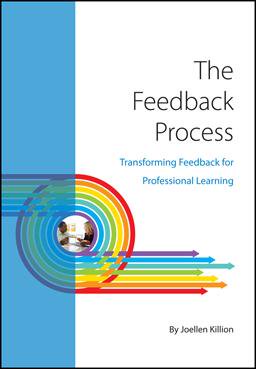 If you agree, I’ve got a book for you!
Joellen Killion, the senior professional learning advisor to Learning Forward (and ABPC’s external evaluator), has written a new book that ought to populate the shelves of all instructional coaches/partners and those who spend time facilitating professional learning.
Titled The Feedback Process: Transforming Feedback for Professional Learning, the book offers insights into reinforcing both learning and continuous improvement through a process that helps the learner “construct” feedback by engaging others in observing and critiquing their application of new practices.
What’s inside The Feedback Process
The book is organized into nine chapters: (1) Feedback Fundamentals; (2) Feedback Defined – and Redefined; (3) Attributes of an Effective Feedback Process; (4) Feedback Conditions; (5) Types of Feedback; (6) Feedback Process; (7) Feedback Evidence; (8) System Feedback; (9) Future of Learning-focused Feedback.
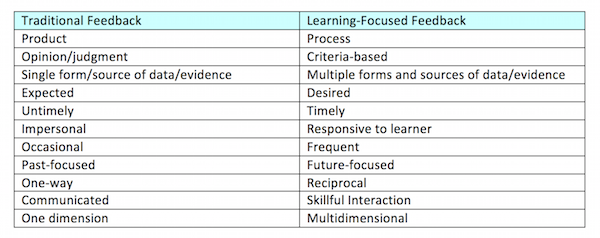
Joellen defines feedback as a “dynamic, dialogic process that uses evidence to engage a learner, internally or with a learning partner, in constructing knowledge about practice and self” (p. 13). To help readers understand the difference between the “traditional feedback” of the past and learning-focused feedback, she provides these contrasts:
Each chapter begins with learning objectives to preview the material for readers and sharpen focus on the main points. For example, one of my favorite chapters (chapter 5) on the types of feedback, identifies four learning objectives:
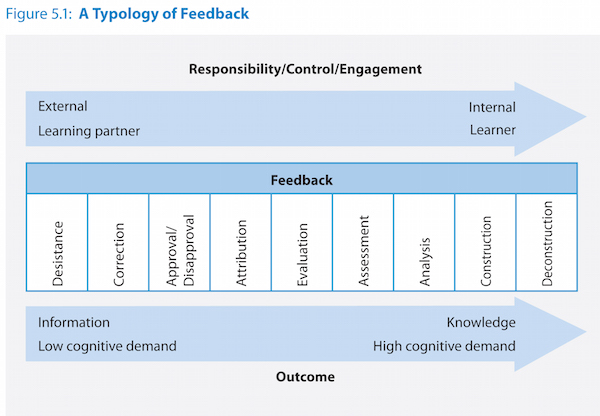
- Study detailed examples of the nine types of feedback: desistance, correction, approval, attribution, evaluation, assessment, analysis, construction, and deconstruction.
- Understand how deconstruction deepens construction by applying new knowledge in different settings.
- Reflect on experiences with different types of feedback and roles that mentors, supervisors, evaluators, learning partners, and learners play.
- Use the tools to analyze current feedback practice.
In my view, chapter 5 alone is worth the cost of the book, as Joellen provides detailed examples of each of the nine types of feedback. Her “typography of feedback” is now posted on my wall because I found it so valuable.
A closer look at Chapter 5: Types of feedback
In this chapter, Joellen also provides an opportunity to reflect on and “practice” the different types of feedback through the creation of scenarios. For example, one of her scenarios may sound all too familiar to some of you who serve more than one school:
The district coach for mathematics provides services to all 10 elementary schools. She runs all day from school to school to meet the growing demands of principals and teachers. She wants to have a better way to prioritize services beyond first-come, first-serve, yet she is finding it difficult to transition to something that might have deeper or more sustained impact.
If you were this district coach’s coach or supervisor, what type of feedback might you provide and how might you ensure that it is received in a way it can be acted upon?
Or, if you are a school-based instructional coach or partner, this scenario might sound familiar to you:
A veteran teacher feels challenged with the district’s new science curriculum for middle grade students. As one of two science teachers in the school, he understands how critical it is that he implements the curriculum as it is written, yet in some cases he needs to revamp his long-standing and successful lesson plans.
 Both the taxonomy and examples of how to use each form of feedback will help you think more deeply about these two scenarios and the other three included in Joellen’s Chapter 5. I “read with my hands” by annotating most every page and noting favorite quotes and concepts in my back-of-book jottings.
Because I really want you to read this book, I don’t intend to write a chapter-by-chapter analysis. Instead, I thought I would share some of “Cathy’s Favorite Quotes”:
- Quoting Carl Glickman (2002): “Without the cultivation of dissatisfaction and critique, without being clear about our purposes, and without the need to use a knowledge base in practice, we have no education and no profession” (p. 31).
- On dialogue: “In true dialogue partners park their judgmental selves at the door and enter with openness to reconsider assumptions and beliefs and be moved by others’ perspectives. Fear and self-preservation are barriers that inhibit the very purpose of dialogue. When the learning partner enters the feedback process as a master, he assumes superiority or expertise that reduces his openness to learning. When this happens genuine dialogue cannot occur. McArthur and Huxham suggest that learning partners act not as masters who declare what is right and wrong, but rather as ushers who accompany adult learners on their learning journey and who are open to their own learning in the process” (pp. 35-36).
- On feedback as a process: “When feedback is thought of as a product rather than a process, seeking input on the feedback is unnatural. In addition, the learner, the recipient of the feedback, is rarely in a relationship that permits or encourages him to provide feedback to the feedback giver” (pp. 66-67).
- On the problems of mixing coaching with evaluation: “First, on the receiving end, my attention will be drawn to the evaluation which drowns out the coaching. If I think I have lost the bonus I already promised to my family, I’m not going to hear your suggestions for how I can tweak my PowerPoint slides. The second concern is that, if I am going to be open to coaching, I need to feel safe. I need to know that admitting mistakes or areas of weaknesses isn’t going to count against me in my job security or career advancement. I need absolute trust that being open in coaching conversations will not adversely affect my evaluation” (An excerpt from Stone & Heen–2014, p. 299; seen on p. 101 in The Feedback Process).
This book is a valuable resource for those of us who work with adults in coaching or development roles. It is my hope that it will bring us closer to the day when feedback is seen as an essential, useful tool designed to make us even better at what we do. And isn’t that what we want, not only for educators, but also for their students?

