
 By Cathy Gassenheimer
“I really don’t know why all of you Americans are visiting us. We have modeled our education system on research and best practice from America.”
This comment from a Finnish education leader came during Alabama State Superintendent Tommy Bice’s visit to Finland several years ago, after marveling at Finland’s progress in improving their schools.
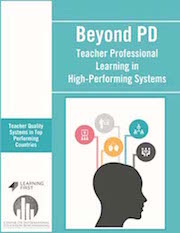 A new report provides some insights into the Finnish response to Dr. Bice. The study, prepared by Learning First and underwritten by the National Center on Education and the Economy (NCEE), highlights the practices of international school systems that have consistently outperformed the United States.
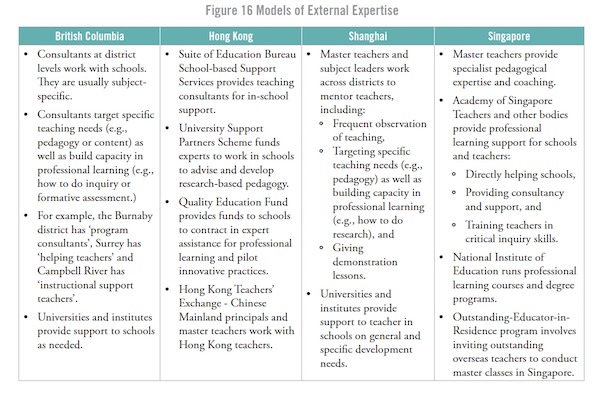
The report, titled Beyond PD: Teacher Professional Learning in High-Performing Systems, highlights four provinces or cities in the nations under study: British Columbia, Hong Kong, Shanghai, and Singapore (a city-state). What the report found was that these four education systems not only recognized the importance of developing their current and future educators but made professional learning the cornerstone of their continuous improvement and accountability systems.
[The report, which includes an embedded six-page executive summary, can be downloaded here. A two-page synopsis (“takeaways”) of the actions of the specific provinces/cities can be read here.]All four systems initiated three common policy reforms that dramatically improved teaching and learning over time:
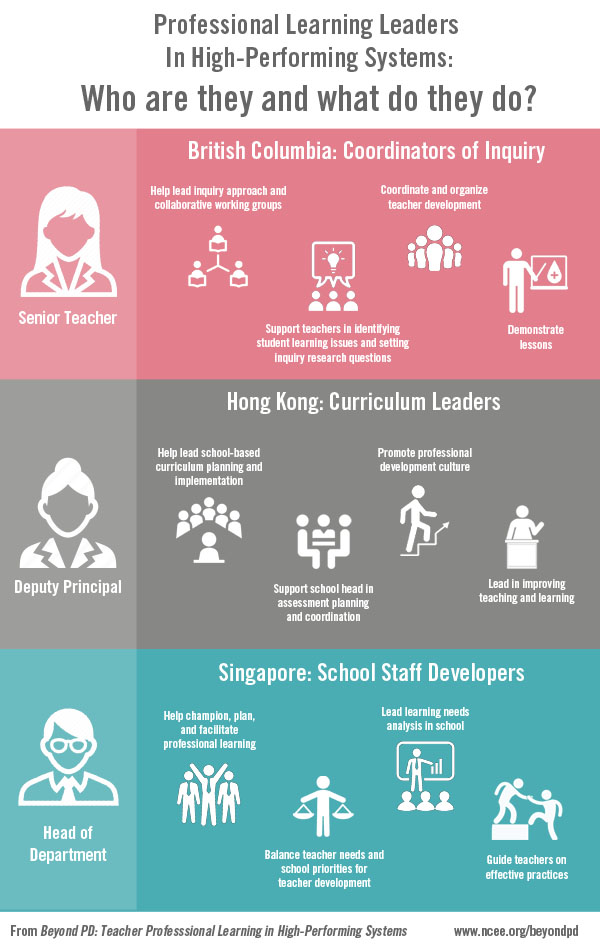
- Developing leaders of professional learning;
- Developing evaluation and accountability policies; and
- Creating time and resources for teachers to engage in ongoing, job-embedded professional learning.
The lead author of the report, Ben Jensen, when referring to the reforms made in the four provinces/regions, noted:
“For all of these people, professional learning is central to their jobs. It is not an add-on. It is not something done on Friday afternoon or on a few days at the end of the school year. Teacher professional learning is how they all improve student learning; it is how they improve schools; and it is how they are evaluated in their jobs. They work in systems that are organized around improvement strategies explicitly anchored in teacher professional learning.” (p. 3)
So why do I make the connection between these findings and the comments of the Finnish educator? Like the leadership in the nations under study here, Finland has drawn heavily on the research about effective school practices conducted by American (and Canadian) scholars and educators.
We have a vast amount of information about what works in schools. The problem in America is that we also have a HUGE knowing/doing gap.
Knowledge about what works isn’t enough
Education, like all professions, has a substantial knowledge base. And, like many professions, education’s knowledge base is rapidly growing. But unless knowledge is put into action, it is wasted.
Teachers can’t teach what they don’t know. If, when they were in school, they were taught largely through lecture-based instruction, we can’t expect teachers to make the shift to more effective methods of instruction without ongoing support and modeling.
Likewise, leaders can’t be expected to manage schools as learning organizations if they are not immersed in ongoing professional growth, with the necessary support to help them move from building manager to lead learner.
No educator, in any position, can improve his or her practice unless given time to learn, collaborate, and reflect on their learning and their teaching.
Yet our investments in professional learning are meager
In most districts, funding for professional learning is minuscule and is often first on the cutting board when the economy takes a downturn or priorities shift. According to the Beyond PD report, such behavior is “penny foolish and dollar poor.”
Simply put, the report finds that investing in the knowledge and skills of teachers and leaders and providing ongoing collaborative learning based on specific school needs is the best way to improve teaching and learning.
How some of the best school systems in the world got better
The report identified five focus areas that all four provinces/cities used to convert their schools into effective learning organizations (p. 4):
- School improvement is organized around effective professional learning.
- Distinct roles are created to lead professional learning in schools and throughout the system.
- Schools and systems recognize and reward the development of teacher expertise (with expertise regularly developed through school-based research on how to improve student learning and then shared and recognized across multiple schools and districts).
- Teachers and school leaders share responsibility not only for their own professional learning but the learning of other teachers and leaders.
- Collaborative professional learning is built into the daily lives of teachers and school leaders.
While none of these recommendations should be surprising, for most districts and schools, moving in this direction would require a realignment of priorities, resources, and time. Fortunately, the report and a set of chapter-by-chapter toolkits provide more information about how the change was accomplished in the four featured systems.
What about Alabama?
All too often, we become fixated with why we can’t change, or with factors that impede our progress but for which we have no control. This report can help shift that thinking. It provides a blueprint that is achievable, even if it might take several years and lots of elbow grease.
At the A+ Best Practices Center, we’re going to continue to share these findings across our networks in the hope that we can identify more and more districts willing to take these steps. I was encouraged during some recent discussion of Beyond PD when an Alabama superintendent noted that he thought the ABPC was helping his district do what the report suggests.
I believe within a few years, and with enough commitment, educators and political leaders from other states and nations will come to visit Alabama schools — and this superintendent and many more Alabama educators will have a very powerful story to tell.

