
 By Cathy Gassenheimer
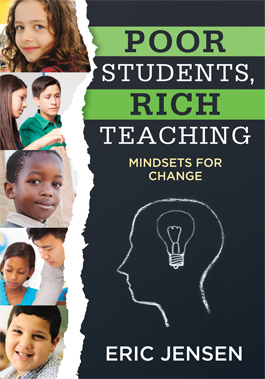
In my post last week about Eric Jensen’s new book, Poor Students, Rich Teaching: Mindsets for Change (Solution Tree, 2016), I summarized the first half of the book (Parts 1 & 2), which addresses the relational mindset and the achievement mindset. I began with Jensen’s essential question:
“If students of poverty are different, whose job is it to do the adjusting?”
In this second and final post, I want to share my learnings from parts 3 and 4, which he titles the rich classroom climate mindset and the engagement mindset.
Part Three: Why the Rich Classroom Mindset?
Part three of Jensen’s book is organized into five chapters, addressing these major themes: voice and vision, safe classroom norms, and academic optimism. The beginning and ending chapters in this section provide information about the secrets to the rich classroom climate mindset and strategies for how to “lock in” this mindset.
 An important, yet simple take-away for me was Jensen’s differentiation of culture and climate, two terms that are often used interchangeably.
Arguing that there is a clear difference between the two, Jensen defined culture as “what we do” (e.g., behaviors and character) and climate as “how we feel.” (p. 110) The connection point, according to Jensen, is when culture “invite[s] reflection on how our behaviors affect us, others, and our school.”
Focusing on both culture and climate is critical to the establishment of a rich classroom climate because doing so invites us to “focus on what students need to succeed, and build that environment every day.” (p. 113)
As I read this section, I was reminded that, while most of this information will not be new to most of us, Jensen is inviting us to be very intentional about ensuring its use strategically so that students are engaged every day in learning.
Critical to that engagement is helping students see the relevance of what they are learning, giving them a voice in what they are learning, and connecting what they are learning to their expectations about their own future (student vision).
Equally important to developing a rich classroom mindset is the establishment of a set of classroom norms that make students feel safe – both to be present in the classroom and to feel comfortable making mistakes and speaking up. Jensen suggests four “cool rules” that actually incorporate most of the norms many of us would believe are essential to a safe classroom culture and climate. Here’s his language:
- Be nice (be good, fair, supportive of others).
- Work hard (come to class prepared to use every minute).
- Make no excuses (don’t blame others or play the victim; be responsible).
- Choose well (life is full of choices – be thoughtful) (p. 128)
 Finally, this part of the book addresses academic optimism, which is essential for many students of poverty who may have lost hope. Jensen suggests five strategies to build academic optimism: (1) Change the roles; (2) show the evidence; (3) change the game; (4) make mastery the endgame; and (5) create a sense of ownership. (p. 135).
I loved Jensen’s suggested new classroom job titles for students, which – for elementary students—shifted terms like line leader to tour guide, bathroom monitor to bouncer, teacher helper to assistant teacher, and pet monitor to zookeeper. (p. 137)
For secondary students, job titles could include chief learning officer, IT specialist, and communication and publicity specialist, to name a few.
The mindset challenge in this part of the book asks readers to gauge their mindset between these two options:
Mindset One: “My job is teaching content. You want all fun and warm fuzzies for students? Tell them to wake up and get with the real world. Class is not supposed to feel good.”
Mindset Two: “The rich classroom climate mindset says, ‘I focus on what students need to succeed and build it into the learning and social environment every day’.” (p. 142)
Part IV: Why the Engagement Mindset?
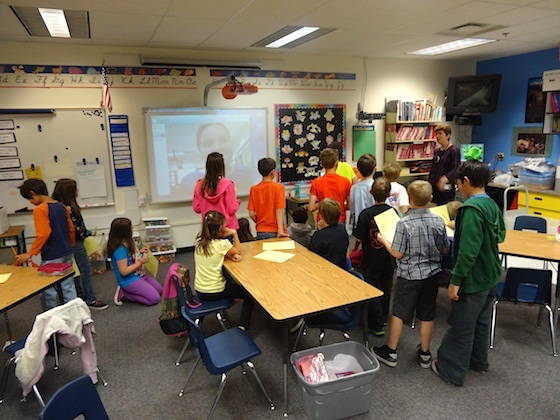
The final section of the book has five chapters that define the engagement mindset, discuss engagement strategies to address both good and bad stress, building buy-in, and building community.
One of my favorite, challenging paragraphs about engaging students is embedded in this section:
“As crazy as it sounds, learning should tickle students’ curiosity, inspire them with role models and heroes, grab them by the scruff of the neck, and serenade them through the highs and lows of emotions to something meaningful. Learning is something that students should feel, make, build, talk about, collaborate with others on, and write about. Learning is something that students need to debate, reflect on, and take positions on. Learning has to engage students in ways that make it worth doing.” (p. 148)
Jensen identifies important states of mind that one should look for in classrooms to determine whether the teacher and students have an engagement mindset:
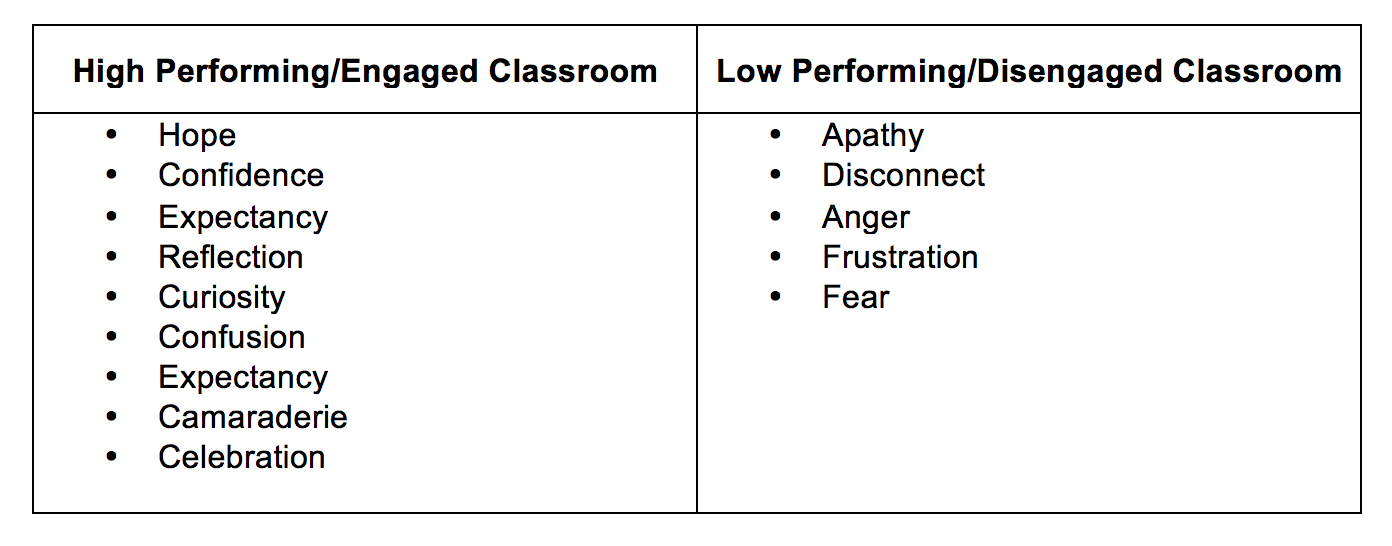
I did a double take when I saw the word “confusion” in the engaged classroom category. Then, upon reflection, I realized that it is sometimes important to “hook” students or cause them to think more deeply – or become more persistent – by allowing them to initially be confused.
The chapter on hooks and buy-ins is full of useful ideas and information ranging from elementary and secondary social hooks, to examples of compelling questions, and building buy-in.
Classroom rituals are central to building classroom community according to Jensen. He suggests five characteristics for successful classroom rituals. Using his language (p. 168):
- They solve a recurring problem (or students won’t see relevancy).
- They include and engage everyone (or you’ll lose participation).
- They are simple and easy to do (students must be able to automate them).
- They are predictable (students should be ready for them every time).
- They must end on a positive emotional state (or students won’t keep doing them).
The mindset engagement question for this final section poses these contrasting views:
Mindset One: “We have a ton of content to cover and usually lecture is the best way to do it. Besides, the engagement strategies are all a bunch of fluff.”
Mindset Two: “The engagement mindset says, ‘I can and will engage with purpose every student, every day, every nine minutes or less, guaranteed’.” (p. 172)
The Final Challenge
As I finished the book, I reflected on Jensen’s final challenge: “If students of poverty are different, whose job is it to do the adjusting?” (p. 183) This challenge reminds us that, as the saying goes, teaching is not for the mild of heart.
It can be hard and emotionally draining to serve students who come from the most challenging backgrounds. But it can also be truly rewarding for those teachers who have the dispositions to be life-changers.
As Parker Palmer reminds us, “what we teach will never ‘take’ unless it connects with the inward, living core of our students’ lives – with our students’ inward teachers.” To do so, we need to work on our own mindsets for, as Palmer also powerfully reminds us:
“We can speak to the teacher within our students only when we are on speaking terms with the teacher within ourselves.” (The Courage to Teach, p. 32)

