
In this three-part series, author and ABPC senior consultant Jackie Walsh shares research-based strategies that can invigorate the classroom learning environment, making it a place where student participation in rich academic conversations is routine.
In Part 1, Jackie highlights the five-stage discussion model she and co-author Beth Sattes recommend in their new ASCD book. In Part 2, she introduces introduce three student capacities essential for productive discussion: social skills, cognitive skills, and use-of-knowledge skills. In her final post, Part 3, Jackie explains how teachers can scaffold conversational skill-building, using three forms of classroom discussion.
You may also be interested in listening to a webinar featuring Jackie and Beth, hosted by ASCD in December 2015. It’s free and simple to use!
 By Jackie Walsh
It is not enough to present the skills of discussion to students; teachers need to actively scaffold student development of these skills. Teachers can scaffold directly – through modeling and coaching – or indirectly, by selecting structures and protocols that will shape and guide student interactions.
The goal is to nurture and support student learning of the skills to the point that students are able to use them independent of the teacher’s intervention. In our book, we refer to these different settings for discussions as “forms” and present three identified forms on a continuum—moving from more teacher control to more student responsibility.
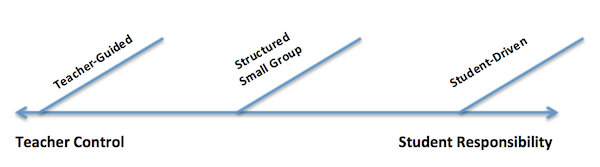
The Teacher-Guided Discussion
In teacher-guided discussion, teachers assume the role of a “master” discussant who models and coaches student apprentices. As a model, the teacher intentionally spotlights selected skills, thinking aloud to students about what she is doing and why.
For example, pausing when a speaker stops talking (Think Time 2) is particularly important in a discussion so as to allow the speaker time to reflect and add to a statement. At an appropriate point following this type of pause, the teacher might say:
“You probably noticed the few seconds of quiet following Jeremy’s comment. This allowed him time to think about what he had said and to decide if he wanted to say more. And he did! During a discussion each of us needs to use this pause to think about what a speaker has said and decide what we think about it. Do we agree? Or disagree? Do we have something to add?”
Teachers can strategically use think-alouds to explain what they are doing as they model key discussion skills.
Teachers also use coaching to actively scaffold student thinking and skill development during a discussion. This often takes the form of offering comments or posing follow-up questions to students.
Comments may be simple positive reinforcements of desired behaviors. For example, following a student’s request to hear from a classmate who had not previously spoken, the teacher might comment:
“I really appreciate Alice’s asking for Marie’s perspective. Everyone else had been talking so much that Marie hadn’t had a chance to say what she was thinking.”
During the early stages of students’ learning about skillful discussion, a teacher may need to:
- request that a student offer evidence to support a statement if a classmate does not;
- invite a student who has not been engaged to pose a question or make a comment;
- encourage students to make connections between text-based knowledge and prior learning; and so forth.
During teacher-guided discussion, the teacher is alert to opportunities to provide these kinds of scaffolds in unobtrusive ways that do not interfere with the flow of the discussion.
Chapter 3 in the book offers a range of research-based strategies that can be used to scaffold and concurrently address common challenges that arise during discussions. Teacher-guided discussions can occur as a whole class or in small groups, depending upon instructional purposes.
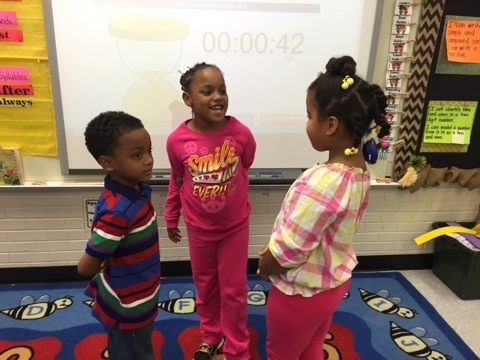 Harlan Elementary, Florence AL
Structured Small Groups
As we move along the continuum, structured small groups are an ideal setting for scaffolding student discussion skills through the intentional use of protocols for this purpose. Protocols provide rules, and sometimes step-by-step procedures to govern who talks when and for how long.
In Chapter 4 of our book, we provide examples of student discussions using 15 different structured small group formats. Many of these protocols will be familiar to you: Think-Pair-Share, Ink Think, Think-Puzzle-Explore, and so forth. The key to their use in developing student discussion skills and processes is to (1) be strategic – selecting a structure that is both appropriate for scaffolding desired skills and for deepening student understanding of content—and (2) be explicit with students as to the expectations.
Additionally, teachers need to actively monitor students as they interact in small group settings and intervene with personal scaffolding when students are confused or fail to follow the protocol.
Following engagement in a discussion scaffolded by small group structures, students should be afforded the opportunity to reflect on their use of intended skills and the ways in which the structure supported this practice.
Student-Driven Discussion
Student-driven discussion requires the highest level of student skill. Students are required to interact independent of teacher guidance and encouraged to scaffold one another.
Socratic Seminars are a well-known form of student-driven discussion if they occur with the teacher seated outside the circle of discussants. There are numerous similar structures for student-driven discussion. Most place a limited number of students (5-9) in an inside circle and position other students on the outside as observers with specific observation tasks.
Chapter 5 in our book showcases a variety of structures for student-driven discussion together with examples of each in use.
Teachers As Designers of Classroom Discussion
Discussion can be a powerful learning strategy for all students—K-12 (and beyond) in all content areas. It does, however, look and sound different at different grade levels and in different content areas. There is no recipe that fits all situations.
There is also no way to summarize all the teaching techniques associated with effective academic conversations in a few blog posts. In Questioning for Classroom Discussion, we provide resources and strategies that teachers can access and use to plan discussions appropriate for their students. We also incorporate multiple examples of focus questions and strategies in use to serve as models, including QR codes that take readers to videotaped classroom discussions.
Our hope is that what I’ve shared in these blog posts will lead you to consider using the book in your professional work. We believe it will serve as a useful manual of practice for individuals and teams of teachers who commit to more intentional planning and facilitation of discussions.
A carefully conceived, well-planned discussion has the potential of engaging the minds and hearts of students, increasing their interest in their studies, and promoting a desire for deeper understanding of issues and topics consequential to their learning and being.
 Jackie Walsh is the co-author, with Beth D. Sattes, of Questioning for Classroom Discussion: Purposeful Speaking, Engaged Listening, Deep Thinking (ASCD, 2015). Jackie works with teachers and school leaders across the United States to improve classroom questioning and discussion. She has co-authored three other books on quality questioning. Jackie is also lead consultant to the A+ Best Practices Center (A+ Education Partnership) where she designs and facilitates professional learning for ABPC’s many educator networks. She lives in Montgomery, AL. Contact her at [email protected]; follow her on Twitter @Question2Think.

