
In this three-part series, author and ABPC senior consultant Jackie Walsh shares research-based strategies that can invigorate the classroom learning environment, making it a place where student participation in rich academic conversations is routine.
In Part 1, Jackie highlights the five-stage discussion model she and co-author Beth Sattes recommend in their new ASCD book. In Part 2, she introduces introduce three student capacities essential for productive discussion: social skills, cognitive skills, and use-of-knowledge skills. In her final post, Part 3, Jackie explains how teachers can scaffold conversational skill-building, using three forms of classroom discussion.
You may also be interested in listening to a webinar featuring Jackie and Beth, hosted by ASCD in December 2015. It’s free and simple to use!
 By Jackie Walsh
Skills are the means and ends of discussion. When students engage in productive discussion, they must be able to bring social, cognitive, and use-of-knowledge skills to bear. In turn, when they are intentional in practicing these skills during classrooms discussions, they are enhancing their ability to use them for thoughtful discourse in academic settings and beyond—in the workplace and in our democratic society.
Improving these skills requires focus and intentionality. So where can teachers turn as they think about which skills to spotlight for their students? In our book we identify a menu of skills, the framework for which appears in the following graphic. A total of 47 discrete skills span the three categories.
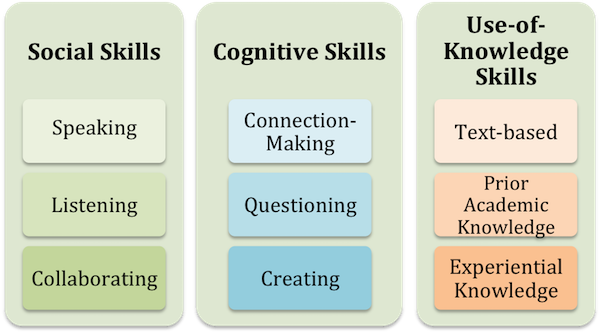
(p. 39, Questioning for Classroom Discussion)
Many of the skills will look very familiar to you as they mirror the requirements of our new standards. Consider social skills, which essentially determine the quality of student interactions one with another. What connections can you make between the examples listed below and the ELA Speaking and Listening standards embodied in CCRS?
- Speaking Skills
- Speaks at length so that thinking is visible. . . .
- Paraphrases portions of a text. . . .
- Listening Skills
- Waits before adding one’s own ideas. . . .
- Looks at the speaking student & gives nonverbal. . . .
- Collaborating Skills
- “Piggybacks” and elaborates on classmates’ comments.
- Actively seeks to include classmates who are not participating.
One of the primary instructional purposes of a discussion is to afford students the opportunity to think more deeply about content, to make personal meaning through individual and collaborative inquiry. The use of cognitive skills moves student talk from a simple exchange of information to dialogue involving more complex reasoning or generative thinking.
Use of the kinds of cognitive skills featured below engage students in the levels of thinking associated with levels 2 and 3 of Webb’s Depth of Knowledge as well as that required by CCRS and Alabama’s new science standards.
- Connection-Making Skills
- Identifies similarities and differences. . . .
- Offers reasons and textual evidence. . . .
- Questioning Skills
- Poses questions to clarify and better understand. . . .
- Asks questions to identify a speaker’s assumptions.
- Creating Skills
- Draws inferences from other speakers’ ideas. . . .
- Integrates information from multiple sources. . . .
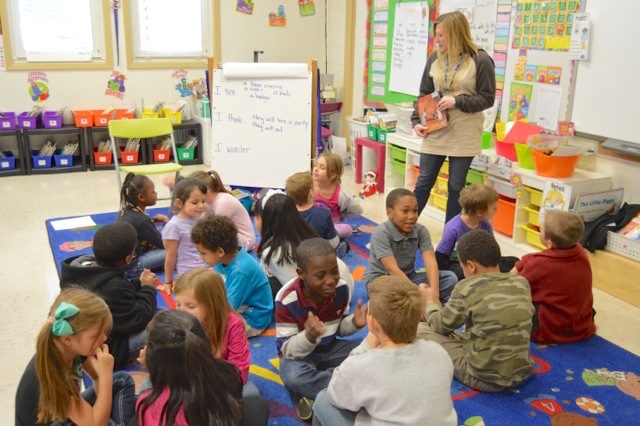 Weeden Elementary, Florence AL
Attending to discussion timing and preparation
One key to the success of discussions relates to timing—the point in an instructional cycle when they occur. Most productive discussions take place only after students have had the opportunity to build or access the knowledge base required for an informed exchange. If this condition is not met, then the discussion may devolve into an “exchange of ignorance.”
Not only do we need to position discussions strategically, we should also afford students the opportunity to get ready. Remember the first stage of the discussion cycle? Preparing oftentimes engages students in the close reading of a text or the careful review of data generated by an experiment or reflection on a solution path to a problem.
When teachers attend to timing and student preparation as they plan a discussion, they pave the way for students’ thoughtful use of knowledge during the discourse. However, as with social and cognitive skills, students need to know teacher expectations in this area.
In our book we suggest that three categories of knowledge can contribute meaningfully to a classroom discussion:
Text-based knowledge is central because it focuses on the topic or issue under consideration. This, of course, is not limited to textbooks, but can include supplemental information accessed online or through relevant print sources—both primary and secondary.
Prior academic knowledge can also serve as important fodder for discussion as teachers strive to encourage students to make connections across the curriculum.
Finally, the meaningfulness of a discussion increases as students incorporate relevant experiential knowledge gleaned from out-of-school learning. We identify specific skills for each of these three sub-categories, but associate the following with all three.
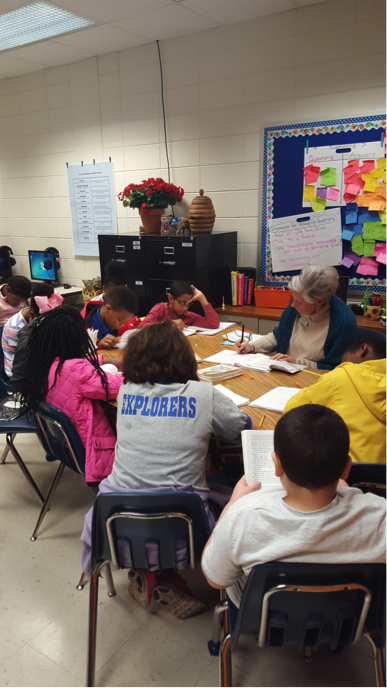 Hibbett Middle School, Florence AL
Using knowledge to deepen discussion
How many of us have had the experience of planning a classroom discussion that ended up feeling like a mere exchange of opinions or, worse yet, a “sharing of ignorance.” Students must understand that the purpose of discussions is to deepen their understanding of content—and that they will be accountable for using knowledge to substantiate their thinking.
- Use-of-Knowledge
- Strives for accuracy in presentation of facts.
- Cites information sources.
- Evaluates the credibility of information sources.
- Relates comments to the subject or question for discussion; does not get off topic.
Addressing the skills
We offer this framework of discussion skills, which is explicated in Chapter 2 of the book, as a resource, imagining that teachers will scan the list to identify the skills most appropriate to their students given student age and developmental level and the content or discipline under consideration.
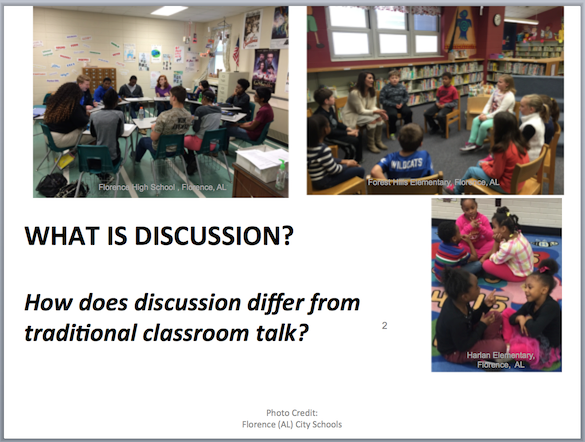
Teachers of primary students might focus more intently on Social Skills, with a limited number of skills from the Cognitive and Use-of-Knowledge categories. High school teachers, on the other hand, are likely to emphasize cognitive and use-of-knowledge skills in concert with social skills.
Regardless of the instructional level, it is important to be explicit with students regarding expectations for skills use. A discussion serves academic purposes only when students and teachers alike attend to these processes that propel and guide it.
Next: Evolving toward student-driven discussion
In my third and final post, I’ll share the three forms of discussion that teachers can use as a continuum of support, scaffolding learning as students move from teacher-guided to student-driven conversations.
 Jackie Walsh is the co-author, with Beth D. Sattes, of Questioning for Classroom Discussion: Purposeful Speaking, Engaged Listening, Deep Thinking (ASCD, 2015). Jackie works with teachers and school leaders across the United States to improve classroom questioning and discussion. She has co-authored three other books on quality questioning. She is also lead consultant to the A+ Best Practices Center (A+ Education Partnership) where she designs and facilitates professional learning for ABPC’s many educator networks. She lives in Montgomery, AL. Contact her at [email protected]; follow her on Twitter @Question2Think.

