
 Think back to a time that you were really in your head.
One of those times when your internal critic was carrying on a dialogue with your vulnerable self, scolding you for something you did, or said, or didn’t get done. Maybe it was reacting to something someone else said to you.
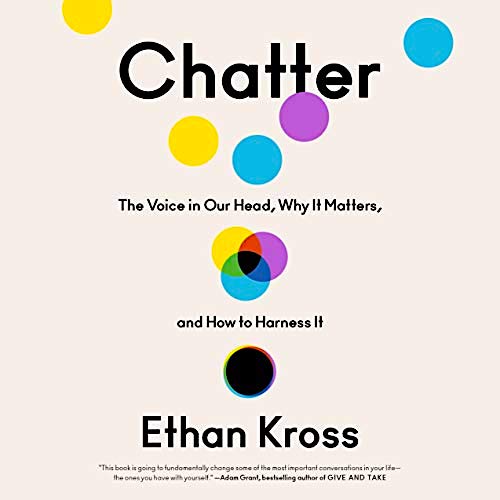
Whatever the case, most of us have these moments – when the stream of conversation in your mind has become what University of Michigan experimental psychologist and neuroscientist Ethan Kross calls “chatter.” In his recent national bestseller, Chatter: The Voice in Our Head, Why It Matters, and How to Harness It, Kross explains why chatter is inevitable but manageable (and even potentially useful) if we teach ourselves how to harness it.
So what exactly is chatter?
 Chatter is comprised of “cyclical negative thoughts and emotions” that interfere with our ability to reflect calmly and productively. Chatter has an immediate negative impact on us as we fall into the loop of reviewing what we did wrong or what happened to us. And like an earworm song that won’t get our of our head, the negative thoughts dominate to the point that they impact the way we think and interact with others (p. xix).
Chatter and the Pandemic
Chatter happens to everyone. Early in the pandemic I experienced chatter, worrying about whether I had been exposed to Covid, even though I really hadn’t left the house. I had dreams about being in a crowded space – an airport or shopping center – filled with people and I wasn’t wearing a mask. I literally awoke in a cold sweat. Thinking (or dreaming) this way was not productive.
Many educators reading this probably experienced Covid chatter: What might happen if a student or colleague exposed you? How could you possibly switch to online learning? How could you possibly keep home-bound students engaged? Some of you may have been able to respond rationally to these questions and develop a plan or a way forward. Others might have experienced chatter, which led to self-criticism and/or frustration.
Turning our chatter off
We all experience chatter at one time or another. The key is to have tools to “turn it off” or redirect it. Dr. Kross identifies eight big ideas that address chatter. I’ve highlighted four of the eight that particularly resonated for me.
Big Idea One: All of us talk to ourselves
“Head talk” can be a good thing. We all have an inner voice that we have become quite accustomed to and often aren’t even aware of. Our inner voice can help us keep on track and improve decision-making. “Our verbal stream plays an indispensable role in the creation of ourselves. The brain constructs meaningful narratives through autobiographical reasoning” that enables us to “write the story of our lives” (p. 15).
Big Idea Two: Chatter can be dangerous
While our inner voice is most often useful, it can take a negative turn. The book captured a devastating story about baseball pitcher Rick Ankiel, who during a National League Division Series game, threw five wild pitches in an inning and derailed his career for a number of years.
Closer to home, you may have found yourself paralyzed by an upcoming presentation or when a lesson went wrong, and you can’t stop the “negative think loop.” Dr. Kross writes:
“Chatter in the form of repetitive anxious thoughts is a marvelous saboteur when it comes to focused tasks. Countless studies reveal its debilitating effects. It leads students to perform worse on tests, produces stage fright and a tendency to catastrophize among artistic performers” (p. 29).
Big Idea Three: Distance is powerful
One of the more intriguing parts of the book involves “distanced self-talk. That’s when someone refers to themselves in the third person. For me, it might be, “Cathy, you can do this. You’ve done it before, and you’ll do it well now.” Read about how NBA superstar LeBron James uses self-talk in this example.
Another way to distance yourself from chatter is to imagine you are advising a friend about the issue currently obsessing you. Or try taking a step back – similar to metacognition – to broaden your perspective and look at the big picture, not just yourself. Kross also suggests shifting your thinking so you see the experience as a challenge rather than a problem or mistake.
Big Idea Four: Nature offers striking restorative effects
A University of Michigan study in the 1970s by psychologists Stephen and Rachel Kaplan found that the natural world could “act like a battery of sorts, recharging the limited attentional reserves that the brain possesses.” They called it “restoration theory” (p. 112). Using our brain to think and perform a task can be draining and most often requires “recharging.” Take a walk, look out the window at trees or pretty scenery. Gaze at a picture of majestic mountains. Listen to a CD track of sounds in a forest.

When I needed to refresh my mental frame of reference, I turned to nature often during the pandemic and found that the quiet wonder of our world does have an amazingly calming impact. Even after a five minute walk, I’m ready to finish writing that blog or tweaking that professional learning design.
“We’re embedded in our physical spaces, and different features of those spaces activate psychological forces inside us, which affect how we think and feel,” writes Kross. “If we make smart choices about how we relate to our surroundings, they can help us control our inner voice.”
So, the next time you find yourself going down a rabbit hole of chatter, think about Kross’s big ideas. And, if I’ve intrigued you, read or listen to the book. It’s chock full of interesting stories, research and tips that can help you use your inner voice for good purposes!

