Written by: Sarah Waldinger, Policy Director
It’s that time of year again! The 2025 Alabama Legislative Session began on February 4, during which important budgetary decisions will be made for Alabama’s schools.
Monday, May 5, 2025
Gov. Ivey Signs FY 2026 Budget Package and the RAISE Act
On May 5, Governor Ivey signed the FY 2026 budget package, including the RAISE Act. This includes the $9.9 billion Education Trust Fund Budget, $524 million FY 2025 Supplemental Budget, $1.28 billion Advancement and Technology Fund, and $455 million from the Education Opportunities Reserve Fund.
The RAISE Act
The RAISE Act (SB 305) is a new law focused on modernizing Alabama’s school funding formula. The first year of implementation will be the 2025-2026 school year. The RAISE Act introduces a hybrid funding formula for Alabama’s K-12 public education system, enhancing the existing Foundation Program to target student needs, such as special education, poverty, and English language learners.
The Educational Opportunities Reserve Fund has directed $375 million to the RAISE Fund to help support the program for the first three years. An additional $58 million has been allocated to the RAISE Act from the Education Trust Fund. In the first year, the RAISE Act will direct $166 million to districts to support students. Based on the ETF budget bill, student weighted allocations will be calculated using a base funding factor of $7,547 in the first year. Student weights will be calculated by using the base funding factor multiplied by the weighted allocation for the specific group. Here is the breakdown of the first year:
- $68.25 million for students in poverty, a weight of 2.25% for each student
- $48.8 million for Special Education students
- Tier 1 students have a weight of 2%
- Tier 2 students have a weight of 10%
- Tier 3 students have a weight of 75%
- $33.5 million for English Language Learners, a weight of 7% for each student in districts where ELL students make up less than 9% of the student population, and a weight of 10% for each student in districts where ELL students make up more than 9%.
- $12.2 million for Gifted Students, a weight of 4.5% for each student for 5% of a school system’s average daily membership (or enrollment)
- $1.17 million for Charter School Students, a weight of 2% for each student
Because the RAISE Act provides weighted allocations for English Language Learners, students in poverty, and gifted students, certain programs within the ETF’s ALSDE budget have been rolled into the RAISE Act line item. The RAISE Act is allocated $58 million from the ETF from the following line items:
- English Language Learners: Decreased by $16.5 million, for a remaining total of $2 million for Regional EL Specialists, which will remain in the ETF budget
- Local Boards of Education At-Risk Student Program: Decreased by $21.2 million, and completely rolled into the RAISE Act
- ALSDE Local School and School System Academic and Financial Improvement Program (At-Risk): Decreased by $9.4 million, for a remaining total of $5.5 million for seven earmarked programs
- Gifted Students Program: Overall, the program decreased by $10.7 million, for a remaining total of $1.7 million. The $1.7 million is earmarked for the Gifted Students Grant Program, which has increased by $250,000 from FY25.
To read more about the RAISE Act, click here. To learn more about the RAISE Act formula calculations, click here. To see a breakdown of funding by district shared with lawmakers, see this story.
FY 2026 Education Trust Fund Budget (ETF)
The FY26 Education Trust Fund Budget (SB 112) totals a record $9.9 billion, a $560 million (6%) increase over last year and the maximum amount that can be spent by law. The budget allocates 67.99% of funds to K-12 schools and programs, and 25.8% to higher education. The spreadsheet can be found here. Here are the highlights:
Alabama Public Charter School Commission
- New Schools for Alabama: $400,000, level funding from FY25
- Charter School Commission: $1.1 million, level funding from FY25
Department of Early Childhood Education
- Office of School Readiness for First Class Pre-K: $197.45 million, a $12 million increase over FY25
- Strong Start/Strong Finish: $4.76 million, a $632,743 increase over FY25
- Dolly Parton Imagination Library: $2.85 million, a $768,004 increase over FY25
Local Boards of Education
- Foundation Program: $4.78 billion, a $143.62 million increase over FY25 This includes $97 million to fund PEEHIP (educator health insurance) rate increases
- Parental Leave for Educators: $9.6 million for the first year
- The RAISE Act: $58 million for the first year
- TEAMS Salary Matrix: $72 million, a $8 million decrease from FY25
- Special Education Teacher Stipends: $7.9 million, level funding from FY25
Alabama State Department of Education
- Advanced Placement: $13.5 million, level funding from FY25
- Alabama Math, Science and Technology Initiative (AMSTI): $136.1 million, a $32.2 million increase from FY25, which includes the following:
- Alabama Numeracy Act (ANA): $95 million, a $27 million increase from FY25
- Data Literacy: $2.6 million, level funding from FY25
- Early Childhood Classroom Assessment: $1.7 million, level funding from FY25
- Alabama Literacy Act (AL Reading Initiative): $151.95 million, a $9.1 million increase from FY25
- K-3 Reading Coaches: $36.8 million, level funding from FY25
- Early Childhood Classroom Assessment: $1.7 million, level funding from FY25
- Alabama Summer and Afterschool Program: $17.29 million, a $14.43 million increase from FY25
- Computer Science for Alabama (CS4AL) Program: $6 million, level funding from FY25
- Regional English Learner (EL) Specialists: $2 million, level funding from FY25
- High Needs Special Education Grant Program: $14 million, a $3.4 million decrease from FY25
- Montgomery Pre-K Pilot Program: $400,000 (moved from Department of Early Childhood)
- Unmet Needs Grant Program: $10 million, level funding from FY25
- School-Based Mental Health Service Coordinator: $4.69 million, level funding from FY25
- Statewide Student Assessment: $20.4 million, a $1 million increase from FY25
- STEM Education Consortium: $900,000, a $150,000 increase from FY25
- Turnaround Schools: $10 million, level funding from FY25
- Office of School Improvement: $2.2 million, a $350,560 increase from FY25
- Principal Leadership and Mentoring Act: $32.6 million, a $1.75 million increase from FY25
- Alabama Teacher Mentor Program: $5 million, level funding from FY25
- Career Coaches Program: $15.7 million, level funding from FY25
- Teach For America: $822,000, level funding from FY25
- High Hopes for Alabama Students: $11.98 million, level funding from FY25
- Jobs for Alabama’s Graduates: $7 million, a $2 million increase from FY25
- Mental Health Telecounseling Pilot Project: $2.5 million for the first year
- Gifted Students Grant Program: $1.68 million, a $250,000 increase from FY25
- Public Education Employee Injury Compensation Program: $15.6 million, a $700,000 increase from FY25
- School Safety, Security, and Climate: $13.2 million, a $2 million increase from FY25
- Educational Delivery Options for Public School Grant Program: $5 million, level funding from FY25
Department of Human Resources
- Child Care and After School Program: $91.5 million, a $7.4 million increase from FY25
- Summer EBT Food Program: $10 million, level funding from FY25
Alabama Law Enforcement Agency
- School Safety: $572,446, level funding from FY25
- School Mapping: $2 million, a $500,000 increase from FY25
Department of Mental Health
- School-Based Mental Health Services Collaboration: $5.5 million, a $1 million increase from FY25
Department of Revenue
- Education Savings Account Program (CHOOSE Act): $101.25 million. This is the first time this program is funded in the ETF, instead of the supplemental budget.
Department of Workforce (previously Department of Labor)
- STEM Council: $4.7 million for the first year
Educational Opportunities Reserve Fund
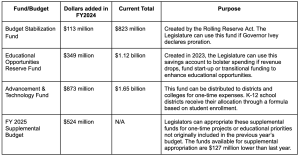
Established in 2022, the Legislature can use this savings account on transformative education programs, which can include funding for existing initiatives like the Alabama Literacy Act or Alabama Numeracy Act, or new innovative initiatives.. The current total in this fund is $1.12 billion. This is the first time the Legislature has chosen to allocate any portion of these funds. Through SB 111, $455 million has been transferred from the Education Opportunities Reserve Fund to the following programs:
- The RAISE Fund: $375 million to support the RAISE Act for the first three years, beginning in the 2025-2026 school year
- Education Savings Account Program (CHOOSE): Up to $80 million to support the CHOOSE Act for the 2025-2026 school year, the program’s first year of implementation. Any funding not needed to fund the CHOOSE Act will be returned to the Educational Opportunities Reserve Fund.
FY 2025 Education Trust Fund Supplemental
The Legislature can use these supplemental funds for one-time projects or educational priorities that were not originally included in the previous year’s budget. Through the FY25 Supplemental Budget (SB 113), $524.2 million was available for disbursement this year . Here are the highlights:
Local Boards of Education
- Textbook Adoption: $28 million
State Department of Education: $136 million total for the following programs
- Ed Farm: $16 million
- AEDs: $2.5 million
- AL Holocaust Commission: $250,000
- School Safety: $15 million, $3 million of which is for School Mapping
- College and Career Readiness Grants: $10 million
- Charter School Grants: $10.3 million
- Principal and Assistant Principal Supplements: $10 million
- School Breakfast Program: $7.3 million
- Summer and Afterschool Program: $30 million
- Struggling Readers Beyond Grade 3: $10 million
- North Alabama STEM Center: $9.5 million
- Statewide Student Assessment: $1 million
- US Government and/or Civics Course Development: $1.5 million
Department of Revenue: $50.5 million total for the following programs
- CHOOSE Act: $50 million
- Education Savings Account (CHOOSE) Administration: $513,000
Department of Early Childhood Education
- Small Magic: $400,000
Advancement and Technology Fund (A&T)
The Legislature can distribute the Advancement and Technology funds to districts and colleges for one-time expenses. K-12 school districts receive their allocations through a formula based on student enrollment. The current total in this fund is $1.65 billion. Through SB 114, $1.28 billion has been allocated from the A&T Budget to the following programs:
- Higher Education: $342 million
- Department of Education
- K-12 school districts: $807.9 million, including the following earmark:
- Ed Farm Classroom of Tomorrow: $2 million
- Matching Grants to LEAs for Regional Career Technology Centers: $100 million
- Reappropriated to LEAs: $35 million
Thursday, April 29, 2025
The Senate concurs with House changes and the FY 2026 Education Budget Package heads to Gov. Ivey’s desk, along with the RAISE Act.
The Senate voted unanimously to concur with the changes in the House-passed budget package. The package includes the FY 2026 Education Trust Fund (SB 112), FY 2025 Supplemental Appropriation (SB 113), Advancement and Technology Fund (SB 114), and Education Opportunities Reserve Fund (SB 111). These bills, along with the RAISE Act (SB 305), have been sent to the Governor for her signature.
When Governor Ivey signs the budget package, watch for a full wrap-up of the FY 26 Education Budget package.
Thursday, April 24, 2025
FY 2026 Budget passes House with minor changes, and RAISE Act passes unanimously
On Thursday, April 24th, the House of Representatives unanimously passed the RAISE Act. Next, the legislation will be sent to Governor Ivey’s desk for signature. Click here to learn more about the RAISE Act.
The House passed the FY 2025 Supplemental, FY 2025 Advancement and Technology Fund, and the FY 2025 Education Opportunities Reserve Act with the changes adopted by the House Ways and Means committee. See our previous updates below for details.
The House passed the FY 2026 Education Trust Fund with one additional change from the committee’s version below in our April 22nd update. Chairman Garrett added an amendment which added language to the ETF that requires the ALSDE to release feedback from the Literacy Task Force to vendors who submit programs for approval under the Alabama Literacy Act.
Next, the budget package goes back to the Senate for them to concur with the House changes or to a conference committee where House and Senate members will compromise on the differences between the Senate-passed and the House-passed versions before it goes to Governor Ivey’s desk for her signature.
Tuesday, April 22, 2025
The FY 2026 Education Budget and the RAISE Act received favorable reports from House Ways and Means Education Committee
Today, Chairman Danny Garrett held a hearing with the House Ways and Means Education Committee on the RAISE Act and the budget package. The committee gave the RAISE Act (SB 305) a favorable report, and did not make any amendments. The committee substituted, or made changes to, the FY2026 Education Trust Fund (SB 112), the Advancement and Technology Fund (SB 114), the Education Opportunities Reserve Fund (SB 111) and the FY 2025 supplemental appropriation (SB 113). All bills received a favorable report, which means they will now go to the House Chamber for a floor vote.
RAISE Act
The RAISE Act (SB 305) is a new proposed law focused on modernizing Alabama’s school funding formula. The RAISE Act introduces a hybrid funding formula for Alabama’s K-12 public education system, enhancing the existing Foundation Program to target student needs, such as special education, poverty, and English language learners.
The House Ways and Means Education committee gave the RAISE Act a favorable report, and maintained the funding structure for the program established in the Senate (outlined below from April 9) with minor changes. In the Education Trust Fund budget bill, the Special Education tiers are now defined as follows:
- Tier 1: Specific learning disability, speech/language impairment, other health impairment
- Tier 2: Autism spectrum disorder, intellectual disability, developmental disability, multiple disabilities
- Tier 3: Emotional disturbance or disability, hearing impairment, orthopedic impairment, visual impairment, deaf-blindness, traumatic brain injury
If a student is in Tier 1, they will generate a weighted allocation of 2%. If they are in Tier 2, they will generate a weighted allocation of 10%, and if they are in Tier 3, they will generate a weighted allocation of 75%. To read more about the RAISE Act, click here.
FY 2026 Education Trust Fund Budget (ETF):
Chairman Garrett introduced a substitute for the ETF (SB 112) in committee. The substitute maintained the majority of the Senate-passed budget items. The changes to the Senate version are outlined below. The House’s ETF amended spreadsheet can be found here.
Local Boards:
The committee kept the same funding levels for the Foundation Program, RAISE Act, Parental Leave, and TEAMS Salary Matrix that were in the Senate-passed ETF bill.
Alabama State Department of Education
The committee kept the same funding levels for the Literacy Act, Numeracy Act, Summer and Afterschool Program, Turnaround Schools, AMSTI, Mental Health Telecounseling Pilot Project, High Needs SPED Grant Program, Advanced Placement, Computer Science, and School-Based Mental Health Service Coordinators. Changes included the following:
- Gifted Students Grant Program: $250,000 increase for a total of $1.7 million, increased from the Senate-passed version and the Governor’s budget
- Statewide Student Assessment: $1 million increase for a total of $20.4 million, which is $1 million more than the Senate-passed budget
- Montgomery Pre-K Pilot Program: $400,000 decrease from $800,000, which is less than the Senate-passed budget
Other Items
The committee kept the same funding levels for First Class Pre-K and the CHOOSE Act. Changes included the following:
- STEM Council: $2 million decrease for a total of $4.7 million, which is less than the Senate-passed budget
FY 2025 Supplemental Budget
Supplemental funds are for one-time projects or educational priorities not originally included in the previous year’s budget. The House’s substitute bill for the FY2025 Supplemental Budget (SB 113) maintained the Governor’s budget total request of $524.3 million, but made some adjustments to line items from the Senate version.
The committee kept the same funding levels for Summer and Afterschool Programs, Struggling Readers Beyond Grade 3, Charter School Grants, the School Safety Initiative, TEAMS, College and Career Readiness Grants, Civics Course of Study, and the CHOOSE Act. Changes included the following:
- Principals/Assistant Principals Salary Supplements: $10 million, which is $4 million less than the Senate-passed bill
- Department of Early Childhood Education for Small Magic: $400,000, which is a new addition to the Senate-passed bill
Education Opportunities Reserve Fund (EORF)
During the committee meeting, Chairman Garrett introduced a substitute for the EORF (SB 111). The substitute maintained the $375 million appropriated to the RAISE Fund from the Senate-passed bill. The substitute added $80 million in appropriations for the CHOOSE Act, so that every eligible student who has applied in this first year of the program will be accepted. This brings the grand total for the CHOOSE Act from the ETF and EORF to $181 million. If the funds for the CHOOSE Act from the EORF are not used in the 2025-2026 school year, they will be returned to the EORF.
Advancement and Technology Fund (A&T)
During the committee meeting, Chairman Garrett introduced a substitute A&T bill (SB 114). While some small changes were made, the bill maintained the Senate-passed allocations for higher education, and the funds directed towards the ALSDE for supporting higher education and K-12 schools as well as the $100 million grant program to develop for LEAs to build regional career technology centers, which is new this year.
Thursday, April 10, 2025
FY 2026 Budget passes the Senate with minor changes
Today, the full Senate unanimously passed the FY 2026 education budget package along with the RAISE Act. The new Senate-passed budget spreadsheet can be found here. See our update below for details on both. The package now moves to the House where it will be reviewed by the House Ways and Means Education committee.
Wednesday, April 9, 2025
FY 2026 Budget passes out of Senate F&TE Committee
The RAISE Act and Budget Package Receive Favorable Report by Senate Finance and Taxation Education Committee
Today, the Senate Finance and Taxation (F&TE) committee Chairman Arthur Orr held a hearing with his committee on the RAISE Act and the Senate’s proposed budget package, which contains several changes to the Governor’s proposals. The budget package includes multiple bills, including the FY2026 Education Trust Fund (SB 112), the Advancement and Technology Fund (SB 114), the Education Opportunities Reserve Fund (SB 111) and the FY2025 supplemental appropriation (SB 113). Additionally, this year the FY2026 Education Trust Fund budget will include line items for the RAISE Act (SB 305 and HB 355), which would establish a hybrid funding model and allocate funds to students with specific needs. All bills received a favorable report. The ETF committee substitute spreadsheet can be found here.
RAISE Act
The RAISE Act is a new bill focused on modernizing Alabama’s school funding formula. The RAISE Act introduces a hybrid funding formula for Alabama’s K-12 public education system, enhancing the existing Foundation Program to target student needs, such as special education, poverty, and English language learners. To read more about the RAISE Act, click here.
The F&TE committee reviewed the RAISE Act today and gave the bill a unanimous favorable report. In the budget package outlined below, the RAISE Act would be funded through an appropriation of $58 million from the Education Trust Fund (ETF) and $108 million from the Education Opportunities Reserve Fund (EORF), for a total of $166 million in its first year.
Because the RAISE Act would provide weighted allocations for English Language Learners, students in poverty, and gifted students, certain programs within the ALSDE’s budget would be rolled into the RAISE Act line item.. The RAISE Act is allocated $58 million from the ETF from the following line items:
- English Language Learners: Decreased by $16.5 million, for a remaining total of $2 million for Regional EL Specialists within the ALSDE budget
- Local Boards of Education At-Risk Student Program: Decreased by $21.2 million, and completely rolled into the RAISE Act
- ALSDE Local School and School System Academic and Financial Improvement Program (At-Risk): Decreased by $9.2 million, for a remaining total of $5.5 million for seven embedded programs within the ALSDE budget
- Gifted Students Program: Decreased by $10.9 million, for a remaining total of $1.4 million for the Gifted Students Grant Program within the ALSDE budget, which was level funded and maintains the Governor’s budget
This is the first year that the Governor’s budget recommended allocating funds from the Education Opportunities Reserve Fund, which was created in 2022. The Governor allocated $100 million to modernize Alabama’s school funding formula. The Senate’s substitute allocated $375 million to be moved from the EORF to the RAISE Act Fund, with $108 million to be disbursed in the first year, $125 million in the second, and $150 million in the third year of implementation.
If passed, a total of $168 million will be disbursed to school systems for the 2025-2026 academic year through the RAISE Act. Based on the ETF budget bill, student weighted allocations will be calculated using a base funding factor of $7,547 in the first year. Student weights will be calculated by using the base funding factor multiplied by the weighted allocation for the specific group:
- Students in Poverty have a weight of 2.25%
- Special Education weights will be based on a student’s tier
- Tier 1 students have a weight of 2%
- Tier 2 students have a weight of 10%
- Tier 3 students have a weight of 75%
- English Language Learners have a weight of 7%
- Gifted Students have a weight of 4.5% for 5% of a school system’s average daily membership
- Charter School Students have a weight of 2%
FY 2026 Education Trust Fund Budget (ETF):
Today, Chairman Orr introduced a substitute bill for the Education Trust Fund in committee. While the Senate maintained the Governor’s total budget request of $9.9 billion for the Education Trust Fund, the Senate substitute bill shifted $3.2 million from the K-12 allocation to the Higher Education allocation as compared to the Governor’s budget. In the Senate substitute, K-12 education receives $6.7 billion and Higher Education receives $2.3 billion. The Senate’s ETF substitute spreadsheet can be found here.
Local Boards:
- Foundation Program: $143.6 million increase for a total of $4.78 billion, which is $9.6 million less than the Governor’s recommendation
- RAISE Act Program: This is a new program, and it is allocated $58 million from the ETF in this first year. As a reminder, another $108 million is allocated from the Education Opportunities Reserve Fund (EORF), a different pot of money which is outlined below. More information about the RAISE Act funding is above.
- Parental Leave: This is a new program, a priority of Governor Ivey, that creates parental leave for teachers and state employees. The Senate allocated $9.6 million in this first year. To read more about this legislation, click here.
- TEAMS Salary Matrix: Decreased by $8 million for a total of $72 million, which is $8 million less than the Governor’s budget
Alabama State Department of Education
- Alabama Numeracy Act: $27 million increase for a total of $95 million, which maintains the Governor’s budget and aligns with Superintendent Mackey’s request
- Alabama Literacy Act (“Alabama Reading Initiative O&M”): $9.1 million increase for a total of $152 million, which maintains the Governor’s budget and increases Superintendent Mackey’s request
- Alabama Summer and Afterschool Program: $14.4 million increase for a total of $17.3 million, which maintains the Governor’s budget
- Turnaround Schools: Level funding for a total of $10 million, which maintains the Governor’s budget
- Alabama Math, Science, and Technology Initiative (AMSTI): $2.5 million increase for a total of $35.7 million. This is $3.6 million less than the recommendation from the Governor’s budget.
- Mental Health Telecounseling Pilot Project: This is a new program, and is allocated $2.5 million in this first year.
- High Needs Special Education Grant Program: Decreased by $3.4 million for a total of $14 million, which is $3.4 million less than the Governor’s budget
- Advanced Placement: $13.5 million total, which is level funding, maintains the Governor’s budget, and aligns with Superintendent Mackey’s request
- Computer Science: $6 million total, which is level funding, maintains the Governor’s budget, and aligns with Superintendent Mackey’s request
- School-Based Mental Health Service Coordinator: $4.7 million total, maintains the Governor’s budget, and lower than Superintendent Mackey’s request
- Statewide Student Assessment: $19.4 million total, maintains the Governor’s budget, and lower than Superintendent Mackey’s request
Other Items
- First Class Pre-K through the Office of School Readiness: $12 million increase for a total of $197.4 million, which maintains the Governor’s budget
- STEM Council: $6.7 million total for the first year, which is $2 million less than the Governor’s budget
- Education Savings Account Program (CHOOSE Act): $101.3 million total, which maintains the program at the required annual funding level and maintains the Governor’s budget. This is the first time the CHOOSE Act has been funded through the ETF in addition to the Supplemental.
FY 2025 Supplemental Budget
Legislators can appropriate these supplemental funds for one-time projects or educational priorities not originally included in the previous year’s budget. The funds available for supplemental appropriation are $127 million lower than last year. The Senate’s substitute bill for the FY2025 Supplemental Budget maintained the Governor’s budget total request of $524.3 million, but made some adjustments to line items.
- Summer and Afterschool Programs: Maintained at $30 million
- Struggling Readers Beyond Grade 3: Maintained at $10 million, which is lower than Superintendent Mackey’s request of $52 million
- Principals/Assistant Principals Salary Supplements: Maintained at $14 million, which is lower than Superintendent Mackey’s request
- Charter School Grants: Maintained at $10.3 million
- School Safety Initiative: $15 million, decreased from the Governor’s budget
- TEAMS Act: Removed from Supplemental, decreased from Governor’s budget
- College and Career Readiness Grants: $10 million, decreased from the Governor’s budget
- Civics Course of Study: $1.5 million, increased from the Governor’s budget
- CHOOSE Act: $50.5 million for the program and its administration, increased from the Governor’s budget
Education Opportunities Reserve Fund (EORF)
During the committee meeting, Chairman Orr introduced a substitute for SB 111, which appropriates funding to the RAISE Fund from the EORF. The bill transfers $375 million from the EORF to the RAISE Fund, and will become effective when the RAISE Act is passed. This deviates from the Governor’s recommendation, but maintains that about $100 million will go towards the RAISE Act for the student weights.
Advancement and Technology Fund (A&T)
During the committee meeting, Chairman Orr introduced a substitute bill for SB 114, which appropriates funds from the A&T fund. The A&T is funded from supplemental appropriations, and schools can use this money for one-time expenses, like upgrading their technology or facilities.
- $342.1 million to higher education
- $807.9 million to ALSDE to support higher ed and K-12 schools
- $100 million to ALSDE for matching grants to LEAs to develop regional career technology centers
Wednesday, February 5, 2025
Alabama State Department of Education Budget Request
Dr. Eric Mackey, Superintendent of Education, presented the ALSDE’s budget request for FY2026 and shared some updates on the department’s work. The ALSDE voted to send this request to the Governor at their October 10, 2024 meeting. Our recap of the October 10 meeting can be read here, and the full budget request spreadsheet from the ALSDE can be found here. The ALSDE’s priorities were also covered in the state board retreat, which were highlighted in the January 30, 2025 Across the Board. Dr. Mackey prioritized the following requests:
- Advanced Placement: $14.5 million for AP, an increase of $1 million over FY25.
- Alabama Numeracy Act: $95 million, a $27 million increase.
- Alabama Reading Initiative: A total of $150.2 million, including $36.8 million for K-3 reading coaches and $600 thousand for certified academic language therapists.
- Struggling Readers Beyond Grade 3: $52 million for a line item that received no funding in FY25, despite a $22 million request.
Computer Science: Level funding at $6 million. - Mental Health Service Coordinators: $7.6 million, an increase of $2.9 million.
- Student Assessment: $32.8 million, an increase of $13.4 million.
- Principal Leadership & Mentoring Act: A total of $38.5 million, including $17.4 million for principal stipends, $11.1 million for assistant principal stipends, and $2.3 million for additional stipends for those working in hard-to-staff schools.
Wednesday, February 5, 2025
Gov. Ivey Releases Proposed Budget
On Wednesday, February 5, Governor Kay Ivey’s budget was released and state agencies presented their FY2026 budget requests to the budget committees.
State Budget Projections
Kirk Fulford, the Deputy Director of the Legislative Services Agency (LSA) presented the state budget projections for the Education Trust Fund (ETF). The ETF is funded primarily through income and sales taxes and allocates funds for all state education activities, including K-12 schools and some higher education programs.
Fulford presented the tax revenues that go into the ETF, and where current legislation requires those funds to flow. He shared the increases and totals from FY2024, which ended in September 2024, and what can be appropriated in the FY2025 Supplemental and the FY2026 budget. The full presentation can be found here.
For the past several years, state tax revenue has been high due to federal funding during the pandemic. In FY2022 and FY2023, revenue was $10.4 billion. In FY2024, revenue increased to $10.6 billion. Even though revenue increased, the maximum amount that the legislature can appropriate in the FY2026 budget is $9.9 billion. This is a 6% increase over the FY2025 appropriation. While ETF revenues are only expected to grow by 1.8%, spending caps over the last few years have led to the ability to increase the budget spending by significantly more and still be below expected revenues.
Similar to recent years, more tax revenue came in than the Legislature appropriated for FY2024. There was a surplus of $1.86 billion, which must flow into four different buckets according to the Rolling Reserve Act. The balance is allocated to specific savings accounts and if there is enough leftover, a supplemental budget:
Governor Kay Ivey’s Budget Proposal
Bill Poole, the State Finance Director and Governor Ivey’s senior advisor, presented the Governor’s priorities for FY2026. The full presentation can be found here, the Governor’s budget spreadsheet can be found here, and the full budget priorities can be found here.
FY 2026 Education Trust Fund budget – The Governor’s proposal for the FY2026 Education Trust Fund allocated $6.7 billion to K-12 funding, and $3.2 billion to higher education and other funding. The budget prioritized the following:
- Alabama Numeracy Act: A $27 million increase for 220 math coaches, which brings the total to $95 million
- Alabama Literacy Act: $7.4 million increase, with a total of $112 million
- Afterschool and Summer Learning Program: A $14.4 million increase, which brings the total to $17.2 million
- Turnaround Schools: Level funded at $10 million
- Alabama Math, Science, and Technology Initiative (AMSTI):$6 million, which brings the total to $39.3 million
- English Language Learners: $10 million increase, with a total of $26.5 million
- First Class Pre-K Expansion and Increased Per Unit Funding: $668k
- CHOOSE Act Funding: $101 million, which funds next year’s (FY 2026) education savings accounts at the required annual funding level. This is the first time funding for the CHOOSE Act has been in the main ETF budget and not the Supplemental.
FY 2025 Supplemental Budget – The Governor’s proposal for the FY 2025 Supplemental budget allocated $348 million of the $524 million to K-12 funding. Additionally, $142 million was allocated to higher education funding, and $34 million to other funding. The Governor highlighted the following priorities:
- Summer and After School Programs: $30 million
- Struggling Readers Beyond Grade 3: $10 million
- Principals/Assistant Principals Stipent Supplements (Principal Act): $14 million
- Charter School Grants: $10.3 million
- School Safety Initiative: $50 million
- TEAMS Act: $5 million
- College and Career Readiness Grants: $20 million
- Civics Course of Study: – $500K
- CHOOSE Act: $50 million, this bring current year’s (FY 2025) funding for the CHOOSE Act ESAs to $100 million, as required by law.
FY 2026 Educational Opportunities Reserve Fund Appropriation – The Governor also proposed spending some of the Education Opportunities Reserve Fund (EORF), which is the first-ever appropriation proposed from this new savings account which was created in 2022. By May 2025, the total of the EORF will be $1.12 billion. She proposed a $133 million appropriation, which includes:
- $100 million to the State Department of Education to go towards the new hybrid formula for student weights. This is one of the potential pathways that the Joint Legislative Commission on Modernizing K-12 Funding has explored. To learn more about the hybrid formula, click here.
- $15 million to the Alabama Department of Workforce
- $3 million to the Alabama Department of Workforce’s Community College Career Pathways Partnership
- $15 million to Higher Education Research Institutions

