
 By Cathy Gassenheimer
With great anticipation, I opened a copy of the latest book by Edgar Schein, the Society of Sloan Fellows Professor of Management Emeritus at the MIT Sloan School of Management. Among many other books, Schein is the author of Helping and Humble Inquiry, both of which have helped shape the work of the A+ Best Practices Center.
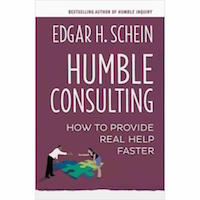
This new book, titled Humble Consulting: How to Provide Real Help Faster, is hot off the press. As I began to read the preface, it did not take long to hook me. Let’s see if you can be hooked as well!
Schein begins the third paragraph this way:
 “In my own experience as a helper, it seemed crucial that the client really be able to tell what is bothering him or her and be able to be open and trusting in doing so. I then discovered that the major inhibiting factor to clients’ being open and trusting is the cultural force in the United States toward telling as being the heroic model….”
Schein says the cultural premium placed on “telling” led to helping and consulting models in the U.S. that were structured around diagnosing problems and giving recommendations. He continues:
“In my own consulting efforts, I found that telling did not work, and furthermore, that the clients who called me in for consultation often had previously experienced the … approach with other consultants and did not find the diagnose and then recommend approach terribly helpful.” (pp. 3-4)
When we ask for help – or, even more challenging, when being told we need help –we feel a loss of independence. As Schein observes in his earlier book, Helping:
“It nevers ceases to amaze me when I observe someone stumbling or falling down on the street how the first thing out of his or her mouth is invariably ‘I’m OK.’ Even when we are clearly hurt we are reluctant to accept the suddenly impose state of dependency.” (p. 32)
Accordingly, to successfully help someone, Schein suggests, the helper needs to focus on strengthening the status of the client (or person being coached) – to resist giving quick answers and spend lots of time listening and understanding what the client wants. This begins a process he calls humble inquiry.
Humble Inquiry leads to Humble Consulting
In his new book, Schein broadens his concept of humble inquiry to humble consulting, which begins with the consultant or coach first exploring “what is really on the client’s mind” and honoring the client’s own curiosity. (p. 7)
Throughout the book, Schein refers to the 3 C’s as important tools when using humble consulting:
• Commitment to helping,
• Curiosity, and
• Caring for the client and the situation.
More specifically, Humble Consulting presumes that “you are committed to being helpful, bring a great deal of honest curiosity, and have the right caring attitude, a willingness to find out what is really on the client’s mind.” (p. 13) These are the keys to building a trusting relationship, which Schein calls a “Level 2 Relationship” with those with whom you are coaching or consulting.
In a recent interview at Google, Schein put it even more succinctly: “It’s all about the relationships!”
 As the world becomes more interdependent and problems become more challenging, humble consulting becomes even more important. In the absence of problems with easy solutions, the old style of diagnosing and recommending solutions doesn’t work very well. When a problem is more complex or “messy,” Schein suggests that the client and the helper work together to “figure out a feasible adaptive move” (p. 194).
An adaptive move requires that both the client and the helper engage in a dialogue to reach greater understanding about the problem and then generate possibilities or “next moves.” Oftentimes, the helper may find him or herself realizing that they don’t have the “right answer” or “right solution,” intensifying the need for adaptive moves and dialogue.
Schein admits that taking a stance of inquiry instead of playing the role of an expert will be challenging for leaders and managers because “they are always supposed to know what to do, to have the vision, to be able to tell others what to do, to be the hero” (p. 195).
One way to shift from the traditional consulting or “expert” model is to become more interested in the process than your own expertise. Instead of trying to convince those with whom you are working that your suggestion or solution is right, Schein suggests stepping back and using your curiosity to ask questions like, “What’s really going on here?” “Can you tell me more about the challenge and what you would like to see resolved?” “Do we have everyone in the room needed to begin to develop a solution?”
According to Schein, this is where humility comes in. Admitting that you are faced with a problem or challenge that has no easy answer is the first step. The next step? Calling on your natural curiosity to learn more about the issue(s) and working with others to craft the next best adaptive move.
► Read selections from Chapter 7 to find out more about Adaptive Moves
25 case studies reveal the book’s wisdom
This book is an essential read for anyone who serves in a helping role: consultants, school-based coaches, instructional partners, school leaders, district support staff and more.
The book features 25 case studies depicting real consulting jobs/challenges in which Schein was involved. Each case study concludes with a “Lessons Learned” section where Schein shares his insights about that specific experience. The case studies are interspersed throughout the book to further demonstrate how Humble Consulting works. In my opinion, the case studies alone are worth the price of this book.
There is no doubt that I will turn to this book time and time again in my work with others. And, as the problems you and your colleagues encounter become more and more complex, this might be the next book for you!
► Listen to Ed Schein summarize his goals for Humble Consulting in this short video.
► Schein often speaks of the influence of Culture. Learn more about what he means.
Should you have the time and interest, this hour-long chat at Google headquarters is one of the most insightful and thoughtful interviews I’ve ever viewed.

