

 By Cathy Gassenheimer
In Part 1 and Part 2 of this series, I highlighted my learnings from Jim Knight’s new book and his recent Learning Forward conference workshop on (1) the beliefs that undergird better conversations among colleagues, and (2) the first five habits that Knight believes can enable better conversations.
This concluding entry reflects on the last five habits that Jim Knight suggests can strengthen our ability to have quality dialogue with others, even in those situations when we are critiquing our work and the work of colleagues.
I’ve yet to meet a person who honestly tells me that they have mastered the art of effective conversations. We’re all works in progress and, to be a bit autobiographical, I’m working on many of these skills daily, stretching to improve.

Habit Six: Being a Witness to the Good
This habit resonates, yet is often so difficult. Knight begins this section of the book with this suggestion: “One of the simplest and most powerful ways to build emotional connections is by sharing positive information with others.” (p. 115) Take a minute to think about a recent occasion when someone shared something positive with you. I bet you’re smiling as you think about this memory.
Yet, too often, we either forget to share, or we’re simply too busy to take the time to make this connection. Knight refers to Winifred Gallagher’s research on attention to help readers understand why being a witness to the good is challenging.
Gallagher points to two types of attention: bottom-up and top-down. Bottom-up attention grabs everyone around the action because it is simply too compelling to dismiss. The examples given in the book range from a school bell at the end of class, the smell of something tasty in the oven, or the angry cry of a baby. This type of attention can be either good or bad; the defining factor, however, is that it cannot be ignored.
Top-down attention is deliberate and only occurs when we intentionally look for something specific and push away extraneous sensory input. Knight points to the example of an instructional coach observing a teacher and trying to avoid distractions in order to remain focused on what the coach has been asked to observe.
The key: “In our lives at work and home, negative experiences often catch our bottom-up attention… To truly be witness to the good, we need to teach ourselves to see all that is going well and not just the aberrations; in other words, we need to use top-down attention.” (p. 118)
Habit Seven: Finding Common Ground
In an increasingly fragmented world, we need more than ever to seek common ground in our conversations with others. Instead, we too often note our differences and miss an important opportunity to connect. Knight reminds us “when we find common ground, we move beyond our differences, and we communicate that we truly see someone else. In this way, finding common ground is a way to show respect.” (p. 135)
Yet, this is easier said than done. In one of the most powerful chapters of his book, Knight suggests why seeking common ground is so challenging. He also suggests a variety of strategies to overcome these barriers.
One simple strategy, fostered by Knight, is a version of the I-CARE acronym:

Habits Eight and Nine: Control Toxic Emotions and Redirect Toxic Conversations
As I prepared to write this post, I reread my notes and found a chilling notation I had made in the margin about these two habits: “Our lives begin to end the day we become silent about things that matter.”
Toxic emotions can “negatively affect us in many ways,” notes Knight. “They can keep us from saying something that should be said, or they can prompt us to say something we will regret.” (pp. 157-158)
One way to limit toxic emotions is to avoid what Knight calls toxic connections. These toxic connections are “any kind of common group that diminishes others. This type of talk is not good for the community or workplace, is demeaning to others, and diminishes our own sense of self.” (p. 146)
For obvious reasons, Knight urges against participating in these toxic conversations and, instead suggests strategies to redirect such conversations once they have begun. A particularly powerful paragraph in the book serves as an important admonition against counterproductive conversations and emotions:
 “The quick hit of pleasure that comes from criticizing a boss or gossiping about a peer usually carries its own punishment. When we engage in a toxic connection, we are at least partially aware that we are being duplicitous, that who we are with one person is not who we are with others” (p. 146).
To successfully redirect a toxic conversation, Knight suggests that we develop a strategy that we can manage. And, as a possibility, he suggests a three-step process: Name it, Reframe it, and Tame it. Furthermore, we need to realize that most often the only emotions we can control in such a conversation are our own.
So, recognizing the conversation for what it is and silently naming it and trying to identify the root cause of our anger can help us remain calm and present.
Reframing a conversation can often help us see a different side of the issue. One way to do this is to commit to being a listener. Pointing back to Habit 2 (Listening with Empathy), Knight notes “when you make it your task simply to take in everything your conversation partner says, you may keep yourself from saying things you will regret.” (p. 161)
Other tactics suggested by Knight include thinking of yourself as a listener; having a personal victory by not allowing your emotions to be triggered; taking a balcony view; and buying time to think. All of these strategies help us tame the conversation and keeping it from getting out of hand.
But what if what is said cannot be ignored and needs to be redirected? The best way is to try to stop a toxic topic before it develops. In organizations, this can be accomplished by establishing norms of behavior and values. If a conversation begins to drift towards a toxic topic or statement, the facilitator or listener can remind the person or group of the accepted norms.
Another strategy involves redirecting conversation by using what Kolb and Williams call “responsive turns.” Responsive turns include four different moves: interrupting, naming, correcting, and diverting. Knight offers a useful table to explain these moves.
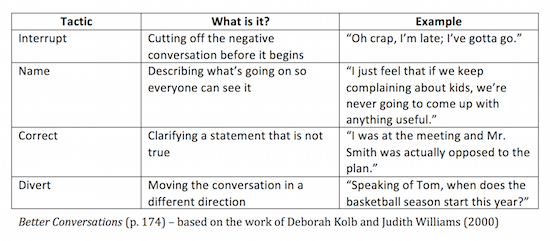
Finally, Knight suggests a tactic that I’ve used in the past: silence. “While staying silent may not seem like a powerful approach for stopping toxic conversations, strategic silence can be as clear a message as an explicit statement. When we are part of a team, and the conversation takes a toxic turn, the best way forward may be simply not to participate in the discussion. Our refusal to participate—our silence—can speak volumes.” (pp. 174-175)
Habit Ten: Building Trust
It is impossible to build a deep relationship without trust. As Knight points out, “Trust stands at the heart of so many of the good things that happen in schools. When teachers trust coaches, meaningful improvement can happen.” (p. 188)
Knight suggests the following five characteristics with accompanying questions to help build trust:
- Character: Are you honest, transparent, and nonjudgmental? Do you need to change so that you can be more trustworthy?
- Competence: How can you increase the usefulness of what you share? Do you need to be more focused or precise? Do you need to increase your depth of knowledge?
- Reliability: What organizational rituals and boundaries can you add, or what activities can you quit so you can be more reliable?
- Warmth: Do you need to get better at demonstrating empathy, listening, being a witness to the good, or being vulnerable to encourage trust?
- Stewardship: Do you need to change your outlook on life in any way so that you are less concerned with yourself and more concerned with others?
A Lifelong Process
 Becoming the person that we want to be—at least for me—is a life-long quest. Knight’s book, Better Conversations: Coaching Ourselves and Each Other to Be More Credible, Caring, and Connected, offers important guideposts to help us get there.
For those of you who coach or manage others, Better Conversations and its companion text, The Reflection Guide to Better Conversations, can be valuable additions to your professional library.

