

 By Cathy Gassenheimer
Want to be more effective at work and in life? Listen more and talk less. This was one of the major themes of the preconference session led by teacher educator Jim Knight at Learning Forward’s annual conference in early December.
Actually, looking over my notes, I see that Jim offered another word to sum up the day: Respect. I’d suggest—and I think Jim would too—that one of the best ways to show respect to someone is to truly listen to them.
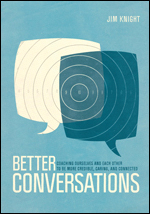 Throughout the day, Knight referred to his new book, Better Conversations: Coaching Ourselves and Each Other To Be More Credible, Caring, and Connected. It’s a valuable resource and a very good read. (Jim talks about his purpose in writing the book in this “trailer” at YouTube.)
Why listening is so important
So why should we work on our communications skills, particularly listening? To build trust. According to one of my favorite education thought leaders, Michael Fullan, the lack of trust makes us feel psychologically unsafe. Feeling unsafe makes it impossible to effectively communicate.
Furthermore, according to Fullan, one of the hallmarks of successful change initiatives is that relationships grow stronger. If relationships improve, things get better. If they remain the same or get worse, we don’t make much progress.
Early in his presentation, Knight reminded us that we’ve never had more ways to connect. Paradoxically, we are more disconnected than ever. Bishop Desmond Tutu called the result of this phenomenon a “radical brokenness in all of existence” (Better Conversations, p. 4).
 MIT professor and author Sherry Turkle puts it this way in another book I’ve been reading, Reclaiming Conversation: The Power of Talk in a Digital Age:
“We are being silenced by our technologies—in a way, ‘cured’ of talking. These silences—often in the presence of our children—have led to a crisis of empathy that has diminished us at home, at work, and in public life” (p. 9).
But, don’t despair quite yet. It is possible to confront this radical brokenness with communications. Turkle reminds us that “Face-to-face communications is the most human—and most humanizing—thing we do” (p. 3).
So how do we reclaim this type of communication through better conversations? Knight suggests that we strive to be authentic. Referencing a quotation by an unknown author, Knight suggested we adopt this mantra: “Be who you are, not what the world wants you to be.” If we truly want to be authentic in our communications, we must pay attention to both our beliefs and our habits.
Six Beliefs Drive Better Conversations
Jim Knight spent considerable time during his day-long workshop exploring a half-dozen beliefs that can help us reshape our habits and become more authentic communicators.
Belief 1: I see conversation partners as equal. In so many ways, this belief recalls Edgar Schein’s suggestion that when communicating with others—particularly when we are coaching or trying to help them—we should “equilibrate” the situation. Very few people like know-it-alls, no matter whether they are chatting at a social event or asking for our help.
For instructional coaches, seeing their peer as equals is perhaps the most critical factor to success. Schein reminds us that “the sense of being one down is clear when one has to ask for help. What is subtler but equally uncomfortable is feeling ‘put down’ by the wrong kind of help or too much help. When someone offers to do something for me that I know I can do for myself, I feel patronized and insulted that the other person would think me incapable of doing it” (Helping, p. 148).
When thinking about viewing others as equal partners, Knight suggests we consider the following contrasts:

Belief 2: I want to hear what others have to say. Instinctively, we can tell if someone is truly interested in what we are saying. Knight points out, “When we listen with empathy to others’ ideas, thoughts, and concerns, we communicate that others’ lives are important and meaningful. When I want to hear what others have to say, I should be fully present in conversations” (p. 30).
Belief 3: People should have a lot of autonomy. Knight often calls this “freedom within form.” To perform at our best, we need to have the flexibility to make good decisions and to operate within a framework of responsibility.
To explore this concept, Knight calls on the research of Edward Deci, an expert on motivation. Deci defines autonomy as “the means to act in accord with one’s self—it means feeling free and volitional in one’s actions. When autonomous, people are fully willing to do what they are doing, and they embrace the activity with a sense of interest and commitment” (p. 31).
Put another way, when forced into an action or activity, most people resist. So Knight encourages us to promote autonomy in our conversations: “When we recognize other people’s need for autonomy, it changes the way we communicate” (p. 32). We do this by offering choices, and enabling others to draw their own conclusions rather then by telling them what to do or think.
 Belief 4: I don’t judge others. Boy, this one is hard for me. Human beings are judging beings and I’d be less than honest if I didn’t admit a tendency to develop false first opinions about some folks I meet. Knight once again calls on Michael Fullan (right) to explain both the importance and difficulty of being nonjudgmental:
“Nonjudgmentalism is a secret of change because it is so heavily nuanced. You have to hold a strong moral position without succumbing to moral superiority as your sole change strategy. As [William] Miller puts it, ‘When we strive for some great good or oppose some great evil, it is extremely difficult not to spill out some of the goodness onto ourselves and the evil onto our opponents, creating a deep personal moral gulf. It is very difficult, in other words, professing or striving for something righteous, to avoid self-righteousness and moral condemnation” (Fullan, Six Secrets of Change, p. 60)
Belief 5: Conversation should be back and forth. When Knight mentioned this, I came up with a mental picture of a Ping-Pong game. Good conversations are shared conversations where each person is paying close attention to the other and balancing both talking and listening.
Combining several of these beliefs, Knight says: “If I see others as equal, if I want to hear what they have to say, if I recognize that people are going to make their autonomous decisions about what I share, then inevitably I will assume that a better conversation is one that is created by everyone in the conversation. Seeing conversation as a two-way interaction is to live out our true respect for the people with whom we communicate” (pp. 35-36)
Belief 6: Conversations Should be Life-Giving. This belief initially stumped me. I wondered how conversations could be life-giving. Fortunately, Knight explains it clearly: “When I believe conversations should be life-giving I go into conversations expecting that my conversation partner and I will leave conversations feeling more alive for having experienced them” (p. 37).
Knight points to the occasions when a conversation moves us deeply and actually affects the way we think. When we approach our conversation partners in this way, we create opportunities for nurturing, growth, and change.
A Ted Talk on empathy
To illustrate these six beliefs and how they promote empathy, Knight showed an excerpt from a much-watched (and much-loved) Ted Talk by Brené Brown on the subject of empathy.

Having better conversations can make a difference, but it requires intentionality, practice, and perhaps changing some habits. In part two of this report on Jim Knight’s Learning Forward workshop, I’ll explore the habits he suggests we adopt that will enable such better conversations to happen.

