

It’s that time of year again! The 2026 Alabama Legislative Session began on January 13, and the Governor’s budget recommendations were released and introduced to the House of Representatives on January 14. Check back here throughout the Legislative Session to learn about important budgetary decisions for Alabama’s schools and students.
Friday, April 10, 2026
Governor Ivey Signs the 2027 Education Budget Package
On April 9, 2026, Governor Ivey signed the FY 2026-2027 Education Budget Package into law. This includes the $10.5 billion Education Trust Fund Budget, $419.7 million FY 2026 Supplemental Budget, $1 billion Advancement and Technology Fund, and $500 million from the Education Opportunities Reserve Fund.
This was Governor Ivey’s tenth and final education budget to sign into law. We are grateful for all she has done over the last 10 years toward the goal of every child in Alabama having a world class education, regardless of circumstance. She has been a true education governor.
The RAISE Act of 2025
As a major budget highlight, we are grateful for the investment Governor Ivey and the Legislature have continued to make in K-12 students and student needs through the RAISE Act of 2025. The 2025 RAISE Act introduced a new hybrid funding formula for Alabama’s public education system, going above and beyond the Foundation Program. This year, the RAISE Act Fund will receive an additional $399 million from the EORF through this budget package, and will total $533 million at the end of this fiscal year.
$191 million will be distributed to districts for student needs, with $58 million coming from the ETF, and $133 million coming from the RAISE Act Fund. This is an increase of $25 million from last year. This year, totals will be calculated using a base of $7,829. Funds will be distributed to districts using the following student weights for the 2026-2027 school year. The estimated funding levels for each student group and totals for each district will be confirmed by the Alabama State Department of Education.
- Students in Poverty: 2.75%, an increase of 0.5% (~$86.8 million, an increase of ~$18.6 million)
- Special Education (~$54 million, an increase of ~$5 million)
- Tier 1 Special Education: 2.5%, an increase of 0.5%
- Tier 2 Special Education: 10%
- Tier 3 Special Education: 75%
- English Language Learners (~$34.4 million, an increase of ~$900,000 )
- ELL students: 7%
- ELL students in High Concentration Areas: 10%
- Gifted Students: 4.75% for 5% of ADM, an increase of 0.25% (~$13.6 million, an increase of ~1.4 million)
- Charter School Students: 2% (~$1.4 million, an increase of ~$300,000)
FY 2027 Education Trust Fund Budget (ETF)
The Education Trust Fund (ETF) funds Alabama’s public education system. The FY27 ETF Budget (HB238) totals a record $10.5 billion, a $570 million (5.7%) increase over last year and the maximum amount that can be spent by law. The budget allocates 67.87% of funds to K-12 schools and programs, and 25.87% to higher education. The spreadsheet can be found here. Here are the highlights and how they compare to last year’s funding levels:
Local Boards of Education
- Foundation Program: $4.98 billion, an increase of $197.3 million. These funds support education employee compensation and benefits, as well as classroom instructional support.
- PEEHIP: Increased by $180 million, which represents a rate of $1,048 per member per month. The PEEHIP board will determine where funds will come from to make up the rest of the $380 million they requested.
- 2% Educator Pay Raise: Added into the Foundation Program’s salary matrix
- Parental Leave for Educators: $9.6 million, level funded
- The RAISE Act: $58 million from the ETF, and $133 million from the RAISE Act Fund for a total of $191 million appropriated for student needs for the 2026-2027 school year
- TEAMS Salary Matrix: $81 million, an increase of $9 million
- Special Education Teacher Stipends: $7.9 million, level funded
- Start-up charters: $2 million, level funded
Alabama State Department of Education
- Advanced Placement: $13.5 million, level funded
- Alabama Math, Science, and Technology Initiative (AMSTI): $159.13 million, an increase of $23 million.
- Alabama Numeracy Act (ANA): $114 million, an increase of $19 million
- Data Literacy: $2.63 million, level funded
- Early Childhood Classroom Assessment: $1.7 million, level funded
- Alabama Literacy Act (“Alabama Reading Initiative O&M”): $151.95 million, level funded
- K-3 Reading Coaches: $36.8 million, level funded
- Certified Academic Language Therapist Stipend Program: $600,000, level funded
- Early Childhood Classroom Assessment: $1.7 million, level funded
- Alabama Summer and Afterschool Programs: $17.29 million, level funded
- Computer Science for Alabama (CS4AL) Program: $7 million, an increase of $1 million
- Children First Trust Fund: $3.05 million, level funded
- Principal Leadership and Mentoring Act: $33.2 million, an increase of $603,115
- Regional English Learner (EL) Specialists: $2 million, level funded
- High Needs Special Education Grant Program: $14 million, level funded
- At-Risk Programs Bucket
- Jones Valley Teaching Farm: $700,000, level funded
- Small Magic: $300,000, funded at $400,000 in last year’s Supplemental
- Youth Advocacy: $300,000
- Pilot Programs Bucket
- Montgomery Pilot Programs for Career Direct Certification, Conflict Resolution, Mechatronics STEM Camp, and Bloom Bucks: $600,000
- Mental Health Telecounseling Pilot Project: $2.5 million, level funded
- Montgomery Pre-K Pilot Program: $150,000, a decrease of $250,000
- Unmet Needs Grant Program: $10 million, level funded
- Statewide Student Assessment: $20.4 million, level funded
- STEM Education Consortium: $1.5 million, an increase of $600,000
- Turnaround Schools: $10 million, level funded
- Office of School Improvement: $2.2 million, level funded
- Alabama Teacher Mentor Program: $5 million, level funded
- Career Coaches Program: $15.72 million, level funded
- Teach for America: $822,000, level funded
- High Hopes for Alabama Students: $11.98 million, level funded
- Jobs for Alabama’s Graduates: $7.05 million, level funded
- Gifted Students Grant Program: $2.45 million, an increase of $779,687
- School Safety, Security, and Climate: $17.8 million, an increase of $4.56 million
- School-Based Mental Health Service Coordinator: $9.25 million, an increase of $4.56 million
- Educational Delivery Options for Public School Grant Program: $5 million, level funded
- National Board Certification of Teachers: $2.05 million, an increase of $550,000
Alabama Public Charter School Commission
- New Schools for Alabama: $400,000, level funding from FY26
- Charter School Commission: $1.1 million, increased by $17,428 from FY26
Department of Early Childhood Education
- Office of School Readiness for First Class Pre-K: $209.87 million, an increase of $12.4 million
- Strong Start/Strong Finish: $4.76 million, level funded
- Voices for Alabama’s Children: $375,000 for this new line item
- Dolly Parton Imagination Library: $3.1 million, an increase of $250,000
Department of Workforce
- STEM Council: $5.2 million, an increase of $500,000
- Focused Talent Retention Initiative: $400,000 for the first time
- Workforce Piloting Solutions: $750,000 for the first time
- Micro School Grant Program: $500,000 for the first time
Other Sections
- Education Savings Account Program (CHOOSE Act) through the Department of Revenue: $86.25 million, a decrease of $15 million due to unused funds in the CHOOSE Fund from last year
- Public Education Employee Injury Compensation Program: $6 million, a decrease of $9.6 million
- Child Care and Afterschool Program through the Department of Human Resources: $91.97 million, an increase of $455,980
- Summer EBT Food Program: $10 million, level funded
- School Safety through the Alabama Law Enforcement Agency: $572,446, level funded
- School Mapping through the Alabama Law Enforcement Agency: $2 million, level funded
- School-Based Mental Health Services Collaboration through the Department of Mental Health: $5.5 million, level funded
- Children’s Health Insurance Program (CHIP) through the Department of Health: $9.25 million
- Move on When Ready through the Commission on Higher Education: $3 million
In addition to the funds appropriated above, the ETF includes a one-time bonus for Alabama’s retired teachers ($1 for every month of service). This is expected to cost $32.9 million, and will be paid for through excess revenues at the end of the fiscal year. This will result in fewer available funds for the 2027 Supplemental appropriation next year.
FY 2026 Education Trust Fund Supplemental
The Legislature uses these supplemental funds for one-time projects of educational priorities that were not originally funded in the previous year’s budget. Through the FY26 Supplemental Budget (HB235), $419.72 million was available for disbursement this year. Below are the highlights:
Local Boards of Education
- Fleet Renewal: $25 million
State Department of Education
- Struggling Readers Beyond Grade 3: $10 million
- Charter School Grants: $10 million
- Summer and Afterschool Program: $30 million
- College and Career Readiness Grants: $20 million
- School Safety: $25 million
- School Mapping: $3 million
- Career Tech Equipment: $10 million
- McWane Center: $8.75 million
- North Alabama STEM Center: $4 million
- LINKS for Parental Education: $1 million
- EdFarm: $10 million
- School Breakfast: $7.3 million
- Back the Blue School Detection Dog Program: $720,000
- Summer Cyber Academy: $400,000
- Jones Valley Teaching Farm: $150,000
Department of Public Health
- Children’s Health Insurance Program (CHIP): $10 million
Department of Revenue
- CHOOSE Act Fund: $100 million
Education Opportunities Reserve Fund (EORF)
The Legislature uses this savings account on transformative education programs, which can include funding for existing initiatives like the RAISE Act, or new and innovative programs. This is the second time that the Governor and the Legislature have chosen to allocate a portion of these funds. Through HB237, $500 million has been allocated from the EORF to the following programs:
- The RAISE Fund: $399 million to support the RAISE Act in future years
- College and Higher Education Excellence and Results (CHEER) Fund: $101 million to support the CHEER Act in future years
Advancement and Technology Fund (A&T)
The Legislature distributes the Advancement and Technology funds to districts and colleges for one-time expenses. K-12 school districts receive their allocations through a formula based on school enrollment. Through HB236, $1 billion has been allocated from the A&T Fund to the following programs:
- Higher Education Formula: $275.1 million
- K-12 School District Formula: $570 million
- Specific K-12 School Needs: $4.9 million
- EdFarm Classroom of Tomorrow: $2 million
- Matching Grants to LEAs for Regional Career Technology Centers: $150 million
Wednesday, April 8, 2026
Legislature Passes the 2027 Budget Package, sent to Governor Ivey
On Tuesday evening, April 7th, the House concurred with the Senate’s changes to the 2027 budget package. Next, the budget goes to the Governor for her signature. Once the package is signed, we will provide a full breakdown of the line items that fund key K-12 programs for students, teachers, and schools.
Thursday, April 2, 2026
Budget Passed by the Full Senate
On Thursday, April 2, the Senate passed the education budget package. Next, the package will go back to the House for it to concur with the Senate changes and then transmit to Governor Ivey for her signature. This is expected to happen next week, during the last week of the 2026 legislative session. Once the Governor signs the budget into law, we will provide a full breakdown of the line items that fund key K-12 programs for students, teachers, and schools.
The Senate passed the FY 2026 Education Opportunities Reserve Act (HB237) and the CHEER Act to support outcomes based funding for higher education (HB565) unanimously, without any changes. The Retiree Bonus bill language (SB380) was added to the Teacher Pay Raise bill language (HB239), and passed unanimously. The Senate made some minor changes to the rest of the bills moving with the education budget.
The RAISE Act
The RAISE Act funds students based on their needs, on top of the Foundation Program. To fund RAISE, $58 million will come from the ETF and $133 million will come from the RAISE Act Fund, for a total of $191 million. This is a $25 million increase over last year. In Chairman Orr’s ETF substitute on the Senate floor, the following weights were set for student needs in the 2026-2027 school year. We are grateful to Governor Ivey and the legislature for their continued support and investment in student needs!
- Students in Poverty: 2.75% weight, which is a 0.5% increase from last year
- Tier 1 Special Education Students: 2.5%, which is a 0.5% increase from last year
- Tier 2 Special Education Students: 10% weight
- Tier 3 Special Education Students: 75% weight
- English Language Learners: 7% weight, with an additional 3% weight for high concentrations
- Gifted Students: 4.75%, which is a 0.25% increase from last year
- Charter School Students: 2% weight
FY27 Education Trust Fund (ETF) Budget
Chairman Orr tabled the Senate F&TE Committee’s substitute, replacing it with a new substitute and one amendment on the Senate floor for HB238. The following changes were made to the Senate F&TE version:
- Montgomery Pre-K Pilot Program: Added at $150,000
- Voices for Alabama’s Children: Added at $375,000
- Gifted Students Program: Increased by $6.5 million, for a new total of $2.5 million
- Retiree Bonus: Increased by $700,000, for a new total of $32.9 million to be paid for through excess revenue.
- Focused Talent Retention Initiative: Added to the budget at $400,000, within the Department of Workforce
- Workforce Piloting Solutions: Increased by $450,000 for a new total of $750,000, within the Department of Workforce
FY26 Supplemental Budget
Chairman Orr tabled the Senate F&TE Committee’s substitute, replacing it with a new substitute on the Senate floor for HB235. Minor changes were made to the Senate F&TE version:
- Struggling Readers Beyond Grade 3: Funding remained at $10 million, but language was added to request that funding be provided to Mobile County schools, including Chastang, Fonde, ER Dickson, Indian Springs, John Will, Meadowlake, Morningside, Orchard, and Whitley.
- McWane Science Center: Increased by $400,000 for a new total of $8.75 million. This funding was in the House version, and had been removed by the Senate F&TE.
Advancement and Technology Fund (A&T)
Chairman Orr amended the F&TE’s Committee substitute for HB236 on the Senate floor. The changes were minimal language edits, and funding levels were not affected.
Wednesday, April 1, 2026
Budget Package Passes out of Senate Finance and Taxation Education Committee
On Wednesday, April 1, 2026, the Senate Finance and Taxation Education Committee (F&TE), led by Chairman Arthur Orr, amended and approved the budget package that passed the House on March 12. The full Senate is expected to vote on the package on Thursday, April 2nd. The committee reviewed the four main budget bills, including the FY 2027 Education Trust Fund (HB238), the FY 2026 Advancement and Technology Fund (HB236), the FY 2026 Education Opportunities Reserve Fund (HB237), and the FY 2026 Supplemental Appropriation (HB235). In addition, the committee passed the following bills that coincide with the budget package:
- Teacher Pay Raise: 2% pay raise for Alabama educators (HB239)
- CHEER Act: Creates an outcome-based funding model for higher education (HB565).
- Retiree Bonus: The committee also approved SB 380, which would provide a one-time bonus ($1 for every month of service) for education retirees and beneficiaries currently receiving benefits from the Teachers Retirement System. This bonus would be paid to retirees in October 2026, and funded with excess revenue from the ETF. The bill was just introduced yesterday by Senator Orr, and if passed by the Senate, would still have to go through the House.
FY27 Education Trust Fund (ETF) Budget
Today, Chairman Orr introduced a substitute bill for the ETF (HB238) in committee. The ETF funds all state education activities, including both K-12 and higher education. The Senate maintained the House’s total budget of $10.48 billion. The Senate made some changes to the House-passed version of the ETF. The Senate committee spreadsheet was not immediately available today, but will be posted here. Key programs that were maintained and changed are outlined below.
Local Boards:
The committee kept the same funding levels for the Foundation Program, PEEHIP, Parental Leave, the TEAMS salary Matrix, and Start-Up Charter Schools. They moved At-risk programs like Small Magic and Youth Advocacy in the House-passed version to a different part of the budget but kept them funded.
The committee maintained the same funding levels as the House version for the RAISE Act. $58 million will come from the ETF, and $133 million will come from the RAISE Act Fund for a total of $191 million for student needs in the 2026-2027 school year.
Alabama State Department of Education:
The committee kept the same funding levels for the Alabama Literacy Act, Alabama Numeracy Act, Summer and Afterschool Program, Principal Leadership and Mentoring Act, Computer Science for Alabama, Advanced Placement, Turnaround Schools, High Needs Special Education, English Language Learners, Gifted Students, and High Hopes for Alabama Students. The Senate made the following changes:
- School-Based Mental Health Service Coordinator: Increased by an additional $1.5 million over the House version, for a total of $9.25 million
- School Safety and Climate: Increased by an additional $1.6 million over the House version, for a total of $17.8 million
Other Items:
The committee kept the same funding levels for First Class Pre-K, the CHEER Act (HB565, pending passage), the Children’s Health Insurance Program (CHIP), and Move On When Ready. The Senate made the following changes:
- CHOOSE Act (Education Savings Account Program): Decreased by $15 million from the House version, for a total of $86.25 from the ETF and $150 from the CHOOSE Act Fund.
- STEM Council: Increased by $5 million from the House version, for a new total of $5.2 million
FY 2026 Supplemental Budget
Supplemental funds are for one-time projects or educational priorities not originally included in the previous year’s budget. The Senate’s substitute for HB235 maintained the Governor’s budget total, request of $419.7 million, and made some minor changes to the House’s version.
The committee kept the same funding levels for Summer and Afterschool Programs, Struggling Readers Beyond Grade 3, Charter School Grants, the School Safety Initiative, College and Career Readiness, Fleet Renewal, the School Breakfast Program, and the Children’s Health Insurance Program. It also maintains moving $100 million from the CHOOSE Act Fund to the Department of Revenue, which allows those funds to be used for CHOOSE’s education savings account tax credit program.
Changes from the House version include the following:
- McWane Center through the Department of Education: Decreased by $400,000 for a total of $8.35 million.
- Alabama Advanced Transportation Readiness Initiative through the Department of Workforce: Added to the Supplemental, for a total of $400,000.
Educational Opportunities Reserve Fund (EORF)
EORF funds are used for transformational opportunities to enhance educational opportunities for students. The committee passed the EORF (HB237) without any changes to the House version. This bill moves $399 million from the EORF to the RAISE Act Fund, and $101 million from the EORF to the CHEER Act if it is enacted.
Advancement and Technology Fund (A&T)
During the committee meeting, Chairman Orr introduced a substitute for the A&T (HB236). Funds from the A&T are distributed based on a formula to K-12 districts and higher education based on student enrollment, and used for one-time expenses like upgrading technology or facilities. While some small changes were made, the bill maintained the House-passed allocations for higher education, K-12 LEAs, specific K-12 projects, and matching grants to LEAs for regional Career Technical Education Centers.
Changes from the House version include the following:
- Coosa County’s Storm Shelter: Added to the budget at $50,000
- Hale County’s Greensboro Campus: Added to the budget at $350,000
- Orange Beach’s Culinary School: Increased by $25,000 for a new total of $350,000
- Coffee County: Decreased by $20,000 for a new total of $230,000
- Montgomery County’s Westside Workforce Development Center: Decreased by $250,000 for a new total of $500,000
Thursday, March 12, 2026
Budget Passed by the full House of Representatives
On Thursday, March 12, 2026, the House reviewed and unanimously passed the FY26 budget package with minor technical tweaks. This includes the four main budget bills: The FY 2027 Education Trust Fund (HB238), the FY 2026 Advancement and Technology Fund (HB236), the FY 2026 Education Opportunities Reserve Fund (HB237), and the FY 2026 Supplemental Appropriation (HB235). The House also approved a 2% pay raise for Alabama educators (HB239) and a proposal to create an outcome-based funding model for higher education (CHEER Act, HB565).
The budget package now goes to the Senate, where Chairman Arthur Orr has tentatively indicated that the Finance & Taxation Education Committee will review it the week of March 30th.
Wednesday, March 11, 2026
Budget Package Passes out of House Ways and Means Education Committee
On Wednesday, March 11, 2026, the House Ways and Means Education Committee (W&ME), led by Chairman Danny Garrett, reviewed and approved the House’s proposed budget package. The full House is expected to vote on the package on Thursday, March 12th. The package contains several changes to the Governor’s proposals. The committee reviewed the four main budget bills, including the FY 2027 Education Trust Fund (HB238), the FY 2026 Advancement and Technology Fund (HB236), the FY 2026 Education Opportunities Reserve Fund (HB237), and the FY 2026 Supplemental Appropriation (HB235). The committee heard initial projections for the FY 2028 fiscal year.The committee also approved a 2% pay raise for Alabama educators and a proposal to create an outcome-based funding model for higher education (CHEER Act).
FY27 Education Trust Fund (ETF) Budget
Today, the committee adopted their substitute bill for the ETF, HB238. The House maintained the Governor’s total budget request of $10.48 billion. In the substitute, K-12 education receives $7.1 billion (72.5%) and Higher Education receives $2.7 billion (27.5%). The House W&ME’s ETF substitute spreadsheet can be found here. Below are some highlights:
Local Boards:
- Foundation Program: $4.98 billion, which is a $20.8 million decrease from the Governor’s recommendation. The Foundation Program includes:
- PEEHIP: Increased by $180 million. This is $30 million less than the Governor’s recommendation. PEEHIP had requested $380 million, so the remainder will have to come out of an existing retiree trust fund for PEEHIP.
- Teacher Pay Raise (HB239): Increased for all public education employees by 2%
- RAISE Act Program: Increase of $25 million, for a total of $191 million to fund student needs in the 2026-2027 school year. $58 million will come from the ETF, and $133 will come from the RAISE Fund. Learn more about the RAISE Act and funding for student needs here.
- Parental Leave: Level funded at $9.6 million. This is $2.4 million less than the Governor’s recommendation. Chairman Garrett confirmed that this amount was sufficient to cover the cost.
- At-Risk Student Programs: $750,000 total. This is a new line item for Small Magic and the Youth Advocacy Program.
- TEAMS Salary Matrix (“Math and Science Teacher Program”): Increase of $9 million, for a total of $81 million.
- Start-up Charter Schools: Level funded at $2 million.
Alabama State Department of Education
- Alabama Literacy Act (“Alabama Reading Initiative O&M”): Level funded at $152 million. This includes:
- K-3 Reading Coaches: Level funded at $36.8 million
- Certified Academic Language Therapist Stipend Program: Level funded at $600,000
- Early Childhood Classroom Assessment: Level funded at $1.7 million
- Alabama Math, Science, and Technology Initiative (AMSTI): Increase of $23 million, for a total of $159 million. This includes:
- Alabama Numeracy Act: Increased by $19 million, for a total of $114 million
- Data Literacy: Level funded at $2.6 million
- Early Childhood Classroom Assessment: Level funded at $1.7 million
- Alabama Summer and Afterschool Program: Level funded at $17.3 million
- Principal Leadership and Mentoring Act: Increased by $603,115, for a total of $33.2 million
- Computer Science for Alabama (CS4AL): Increased by $1 million, for a total of $7 million
- School-Based Mental Health Service Coordinator: Increased by $3 million, for a total of $7.7 million
- Advanced Placement: Level funded at $13.5 million
- Turnaround Schools: Level funded at $10 million
- English Language Learners: Increase of $2 million, for a total of $4 million for regional specialists
- High Needs Special Education Grant Program: Level funded at $14 million
- Statewide Student Assessment: Level funded at $20.4 million
- School Safety and Climate: Increased by $3 million, for a total of $16.2 million
- Gifted Students: Increase of $100,000, for a total of $1.8 million
- High Hopes for Alabama Students: Level funded at $12 million
Other Items
- First Class Pre-K through the Office of School Readiness: Increase of $12.4 million, for a total of $209.9 million
- CHOOSE Act (Education Savings Account Program): $251 million total, with $101 from the ETF and $150 million from the CHOOSE Act Fund.
- CHEER Act (HB 565): $65 million appropriated for the first year of the new outcomes-based funding model for higher education, if it is passed this session
- STEM Council: Level funded at $4.7 million
- Children’s Health Insurance Program (CHIP): Split between the ETF and Supplemental, $9.3 million
- Move on When Ready: New funding of $3 million. This is a new line item for the Move on When Ready Act of 2025.
FY 2026 Supplemental Budget
The committee adopted their substitute for HB235, which appropriates supplemental funds for one-time projects or educational priorities that were not originally included in the previous year’s budget. This year, $419.7 million is available for supplemental appropriations. This is $104.6 million less than the FY25 Supplemental last year, and maintains the Governor’s total recommendation. Some adjustments were made to specific line items. Here are some highlights:
- Summer and Afterschool Programs: Level funded at $30 million
- Struggling Readers Beyond Grade 3: Level funded at $10 million, which is lower than Governor’s request of $45 million and Superintendent Mackey’s request of $54 million
- Charter School Grants: Decreased by $300,000, for a total of $10 million
- School Safety Initiative: Increased by $10 million, for a total of $25 million
- College and Career Readiness Grants: Increased by $10 million, for a total of $20 million
- CHOOSE Act: Increased by $50 million, for a total of $100 million for FY 2026
- Fleet Renewal: $25 million
- School Breakfast Program: Level funded at $7.3 million
- Children’s Health Insurance Program (CHIP) Program: $10 million, in addition to the $9.3 in the ETF
Educational Opportunities Reserve Fund (EORF)
- The committee adopted their substitute for HB237, which appropriates funds for transformational education initiatives. The substitute transfers $500 million from the EORF to the following funds:
- RAISE Fund: $399.2 million transferred for RAISE appropriations in future years
- CHEER Fund: $100.9 million transferred for CHEER, if the CHEER Act of 2026 is enacted
The CHEER Act (HB565) would establish the process to provide bonus funding to higher education institutions that meet specific goals and objectives.
Advancement and Technology Fund (A&T)
The committee adopted their substitute for HB236, which appropriates funds from the A&T fund. The A&T is funded from supplemental appropriations, and schools can use this money for one-time expenses, like upgrading their technology or facilities.
- Higher Education: $275.1 million
- K-12: Distribute to LEAs based on the A&T formula: $570 million
- K-12: Distribute for specific K-12 projects: $4.9 million
- K-12: Matching grants to LEAs for regional Career Technical Education Centers: $150 million, an increase of $50 million over last year’s appropriation. This is a priority of Speaker Ledbetter and other members.
Thursday, February 5, 2026
ETF Budget Hearings
On February 2, the House Ways and Means Education and the Senate Finance and Taxation Education Committee members gathered for the Education Trust Fund (ETF) budget hearings. The committees heard testimony from the Retirement Systems of Alabama (RSA), the Alabama Community College System (ACCS), the Alabama Commission on Higher Education (ACHE), and the State Department of Education (ALSDE).
Neah Scott, Legislative Counsel for the Retirement Systems of Alabama (RSA), presented on the department’s budget request. She highlighted the Public Education Employees’ Health Insurance Plan (PEEHIP), which is the state’s health insurance program for teachers and the Teachers’ Retirement System (TRS). Scott emphasized the increased appropriations request for PEEHIP, noting that more people are using the program, those in the program are using more services, and those services are becoming more expensive. PEEHIP supports 355,000 public education employees, retirees, and dependents, and the program is facing a $380 million shortfall. To make up for this shortfall, the RSA is requesting $274 million from the ETF, which is $122 million over the Governor’s recommendation. This would bring PEEHIP’s total from the ETF to $1.09 billion for FY27. The RSA is also requesting $778 million for the TRS, which is an increase of $3 million over last year’s budget. About $10.5 billion is available for appropriations in the ETF this year, and the RSA is requesting about 17.8% of that total budget.
Dr. Eric Mackey, Alabama State Superintendent of Education, presented the Alabama Department of Education’s (ALSDE) budget request. Mackey highlighted the success that Alabama students have achieved, including incredible gains in 4th-grade math and 3rd-grade reading through the Alabama Literacy and Numeracy Acts. He emphasized the need to fund increasing transportation costs, Struggling Readers Beyond Grade 3, and the programs that are currently working for Alabama students. Budget request totals for the ALSDE’s priorities include:
- Alabama Reading Initiative: $112.8 million, aligned with the Governor’s recommendation
- K-3 Reading Coaches: $36.8 million, aligned with the Governor’s recommendation
- Struggling Readers Beyond Grade 3: $54 million, $7 million over the Governor’s recommendation
- Alabama Numeracy Act: $114 million, aligned with the Governor’s recommendation
- English Learners: $4 million, aligned with the Governor’s recommendation
- Principal Leadership Mentoring Act: $33.2 million, aligned with the Governor’s recommendation
- Computer Science for Alabama (CS4AL): $7 million, aligned with the Governor’s recommendation
- Advanced Placement: $14.5 million, $1 million over the Governor’s recommendation
- Math & Science Teacher Salary Matrix (TEAMS): $87 million, $15 million over the Governor’s recommendation
- Career Tech Initiative: $53.7 million, $15 million over the Governor’s recommendation
- Mental Health Service Coordinator Program: $7.65 million, aligned with the Governor’s recommendation
- Transportation: $615.4 million, $29.1 million over the Governor’s recommendation
- School Safety, Security, & Climate: $52.9 million, $14 million under the Governor’s recommendation
Dr. Jim Purcell, Executive Director for the Commission on Higher Education, presented on Higher Education’s budget request. Purcell emphasized the importance of higher education, and provided data on salaries for those who earn advanced degrees as compared to those who earn high school degrees. The further that Alabamians go in school, the more money they earn annually and over their lifetime. In 2023, the median annual income for high school graduates was $35,397, as compared to college graduates with a bachelor’s degree, who earn $57,000.
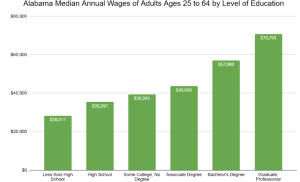
The Commission on Higher Education requested a total of $87.7 million from the ETF, which is a $2.5 million increase over FY26. These funds support student financial aid, grants and scholarships, the Paralympics, and programs like Pathways to Progress.
For more information about the budget hearings, check out this article by the AL Daily News.
Wednesday, January 14, 2026
Budget bills introduced in the Legislature
On January 14, Chairman Danny Garrett introduced four education budget bills to the House of Representatives. These bills outlined budgets for the Education Trust Fund (ETF), the FY26 ETF Supplemental, the Advancement and Technology fund, and the Education Opportunities Reserve Fund, and they reflect the Governor’s recommended budget package.
The ETF budget bill, HB 238, will fund Pre-K-12 and higher education programs in Alabama for the Fiscal Year 2027, and the 2026-2027 school year. The bill that was introduced follows the Governor’s recommendations, appropriating $10.47 billion for K-12 and higher education. The bill language can be found here, and Governor Ivey’s budget spreadsheet with comparisons to FY26 can be found here.
The Educational Opportunities Reserve Fund (EORF) budget bill, HB 237, transfers funds from the EORF savings account to the Renewing Alabama’s Investment in Student Excellence (RAISE) Act Fund and appropriates funding for various higher education institutions. Higher education is allocated $137.6 million that will be used to fund the new outcomes-based funding model that Chairman Orr and Chairman Garrett are proposing this year. The RAISE Act Fund will receive $362.4 million to support the state’s commitment to continuing and expanding the funding of student needs. This is in addition to the $375 million that was transferred from the EORF to the RAISE Act Fund last year. The bill language can be found here, more information on the RAISE Act can be found here, and this Alabama Daily News article has more information about outcomes-based funding.
The Advancement and Technology budget bill, HB 236, will appropriate $1 billion for one-time expenses to K-12 school systems and higher education programs. The bill allocates $624.9 million to K-12, $275.1 million to higher education, and $100 million to the Department of Education to provide matching grants to expand regional career tech centers. Each school district will receive funds based on a formula, and the exact funding levels can be found in the bill.
The FY26 ETF Supplemental budget bill, HB 235, appropriates funds that were left over from FY26. The bill that was introduced follows the Governor’s recommendations, appropriating a total of $419.7 million. The bill also directs a separate $100 million to be appropriated from the CHOOSE Act for the program in the 2026-2027 school year. The bill language includes the following K-12 priorities:
- Struggling Readers Beyond Grade 3: $45 million – This was a big priority for the ALSDE, which requested $52 million.
- Social Studies Curriculum Project: $7 million
- Department of Public Health for CHIP: $19.25 million
- Career Tech: $15 million
- Charter School Grants: $10 million
- College and Career Readiness Grants: $20 million
- Summer and Afterschool Programs: $30 million
- School Safety: $50 million
Wednesday, January 14, 2026
Governor Ivey’s Budget Proposal; State Budget Projections
On Wednesday, January 14, Governor Kay Ivey’s budget proposal was released. Additionally, during the Joint Legislative Budget Overview, legislators heard from State Fiscal Officer at the Legislative Services Agency (LSA) Kirk Fulford and Finance Director Bill Poole on Alabama’s budget projections for Fiscal Year 2026-2027 (FY27). Governor Ivey’s budget spreadsheet can be found here, and Kirk Fulford’s full presentation can be found here.
Alabama Budget Basics
The Alabama Legislature has two budgets – the Education Trust Fund, which funds all state education activities, including K-12 school systems, two-year colleges, and public four-year colleges and universities, and the General Fund, which funds all other state activity. Historically, the ETF has grown by about 3-4% each year.
To begin the budget process, all agencies, including the Alabama Department of Education (ALSDE), send their priorities and requests to the Governor’s office in November. The Governor then puts together a proposal for the ETF and General Funds, that are then considered by the Alabama Legislature.
The ETF is funded primarily through income and sales taxes, contributing to the fund’s projected annual total. The governor’s office and the legislature budgets for the following school year by estimating the total that will be available in the fund, but the increase in spending in the ETF budget is also capped at 5.75% growth or the average growth in the last 15 years, whichever is lower. In most years, more tax revenue will come in than is allocated in the budget. When there is a surplus, funds flow to three different savings accounts and one additional budget that can be allocated by the legislature. These include:
- Budget Stabilization Fund – Created by the Rolling Reserve Act, this fund can be used only if the Governor declares proration.
- Educational Opportunities Reserve Fund – Created in 2023, this savings account can be used to bolster spending if revenue drops, or to fund transformative educational opportunities. This fund was used for the first time in 2025 to support the RAISE Act and the CHOOSE Act.
- Advancement & Technology Fund – This fund can be distributed, through a predetermined formula, to K-12 school districts and colleges for one-time expenses.
- ETF Supplemental Budget – If funds are left over from the previous year’s Education Trust Fund budget and the above savings accounts are funded, this fund can be used for one-time projects or educational priorities that were not originally included in the previous year’s ETF budget.
FY2027 State Budget Projections
Kirk Fulford presented on where the ETF currently stands, what projected growth may look like, and the totals in each of the savings accounts. The maximum amount that the legislature can appropriate in the FY2027 ETF budget is capped at $10.47 billion. This is an increase of $569.7 million, or 5.75%, over FY2026.
- Budget Stabilization Fund – $116.3 million added in FY25, for a current total of $939 million. These dollars are only accessible during proration.
- Educational Opportunities Reserve Fund – $297.8 million added in FY25, for a current total of $1.04 billion. The legislature could choose to appropriate up to the total balance of this fund.
- Advancement & Technology Fund – $744.5 million added in FY25, for a current total of $1.12 billion. The legislature could choose to appropriate up to the total balance of this fund.
- FY26 ETF Supplemental Budget – $446.7 million available from the FY25 overflow. $27 million has already been appropriated, so the legislature has $419.7 million left to appropriate for this year.
Beyond the FY2027 budget, Fulford also looked towards recent federal legislation, the One Big Beautiful Bill Act passed in July 2025, that will impact Alabama’s budget this year and beyond. He highlighted that the law impacts tax provisions for individuals and corporations, the Supplemental Nutrition Assistance Program (SNAP), and Medicaid. Beginning FY2027, Alabama will incur an additional cost of $39.8 million for SNAP administration, and could be responsible for over $173 million of SNAP payments to families beginning in FY2028. To read more about OBBBA’s impact on Alabama’s schools, students, and state budget, click here.
Fulford shared that in the years following the COVID-19 Pandemic, state tax revenues were extremely high due to federal funding increases. He projected that this fiscal year will return to pre-pandemic growth rates, impacting the total amount the legislature may have to distribute in future fiscal years. Along with ETF considerations, like PEEHIP for employer healthcare, teacher pay raises, and programmatic increases for the RAISE Act, Numeracy Act, and others, Fulford prepared the legislators for the main funding shifts they will consider this session.
FY2027 Governor’s Recommended Education Trust Fund Budget
The Governor’s proposal for the FY2027 ETF Budget allocates the maximum allowable expenditure of $10.47 million. The recommendation directs $7.1 billion (68%) to K-12 funding, $2.7 billion (26%) to higher education, and $646 million (6%) to other programs.
Within the K-12 funding recommendations, $4.99 billion was allocated for the Foundation Program to support the state’s resource-based formula for funding public schools. This is a $218 million increase from FY26, which supports teacher pay raises, PEEHIP increases, and TRS rate increases.
Governor Ivey’s budget prioritizes the following Pre-K-12 initiatives:
- RAISE Act: Level funding at $58 million. This will be combined with $133 million from the existing RAISE Act Fund to support student needs for the 2026-2027 school year, for a total of $191 million.
- Alabama Literacy Act (“Reading Initiative”): Level funding at $112.8 million.
- Alabama Numeracy Act: $114 million total, increasing by $19 million from FY26.
- Advanced Placement: Level funding at $13.5 million.
- Afterschool and Summer Learning Program: Level funding at $17.2 million. This was a priority for the ALSDE’s budget proposal, which requested $47.2 million.
- Charter School Commission: $1.5 million total, increasing by $17K from FY26
- Principal Leadership and Mentoring Act: $33.2 million, increasing by $1 million from FY26.
- Turnaround Schools: Level funding at $10 million.
- School-Based Mental Health Service Coordinator: $7.6 million total, increasing by $3 million from FY26.
- Department of Early Childhood: $226.6 million total, increasing by $13.4 million from FY26 to support the Office of School Readiness, which includes a $9.7 increase for First Class Pre-K, and a $250,000 increase for the Dolly Parton Imagination Library.
- Parental Leave: $12 million total, increasing by $2 million from FY26.
- CHOOSE Act Funding: Level funding at $100 million. This will be combined with $150 million that was directed from this year’s revenues before they entered the ETF for a total of $250 million.
- Alabama Math, Science, and Technology Initiative (AMSTI): $38.8 million, increasing by $3 million from FY26. This was a priority for the ALSDE’s budget proposal, which requested $57.8 million.
- Dual Enrollment: $54.2 million, increasing by $10 million from FY26. This was a priority for the ALSDE’s budget proposal, which requested $79.2 million.
- Public Education Employee Injury Compensation Program: Level funding at $15.6 million.
- Workforce Development: Level funding at $49.3 million
Governor Ivey’s Additional Funding Recommendations
Governor Ivey made recommendations for the FY26 ETF Supplemental Budget, as well as the Advancement & Technology fund. These recommendations were presented by State Finance Director Bill Poole.
Governor Ivey’s proposal for the FY26 ETF Supplemental was split, with $274 million (65%) going towards K-12 funding, $109 million (26%) going towards Higher Education funding, and $36 million (9%) going towards other programs. The proposal recommends:
- Career Tech: $15 million
- Charter School Grants: $10 million
- College and Career Readiness Grants: $20 million
- Summer and Afterschool Programs: $30 million
- Ed Farm Coding Workforce Training: $15 million
- Fleet Renewal for School Buses: $66.5 million
- School Safety: $50 million
- Specialty High Schools (ASFA, School of Math & Science, Cyber School, and Healthcare Sciences): $1.5 million each
- Struggling Readers Beyond Grade 3: $45 million – This was a big priority for the ALSDE, which requested $52 million.
- Universities for Capital Projects or Deferred Maintenance (Higher Education): $84.7 million
- Department of Workforce (other): $6.5 million
Poole also shared that Governor Ivey’s proposal for the Advancement & Technology Fund will include distributing $1 billion of the $1.1 billion account.

